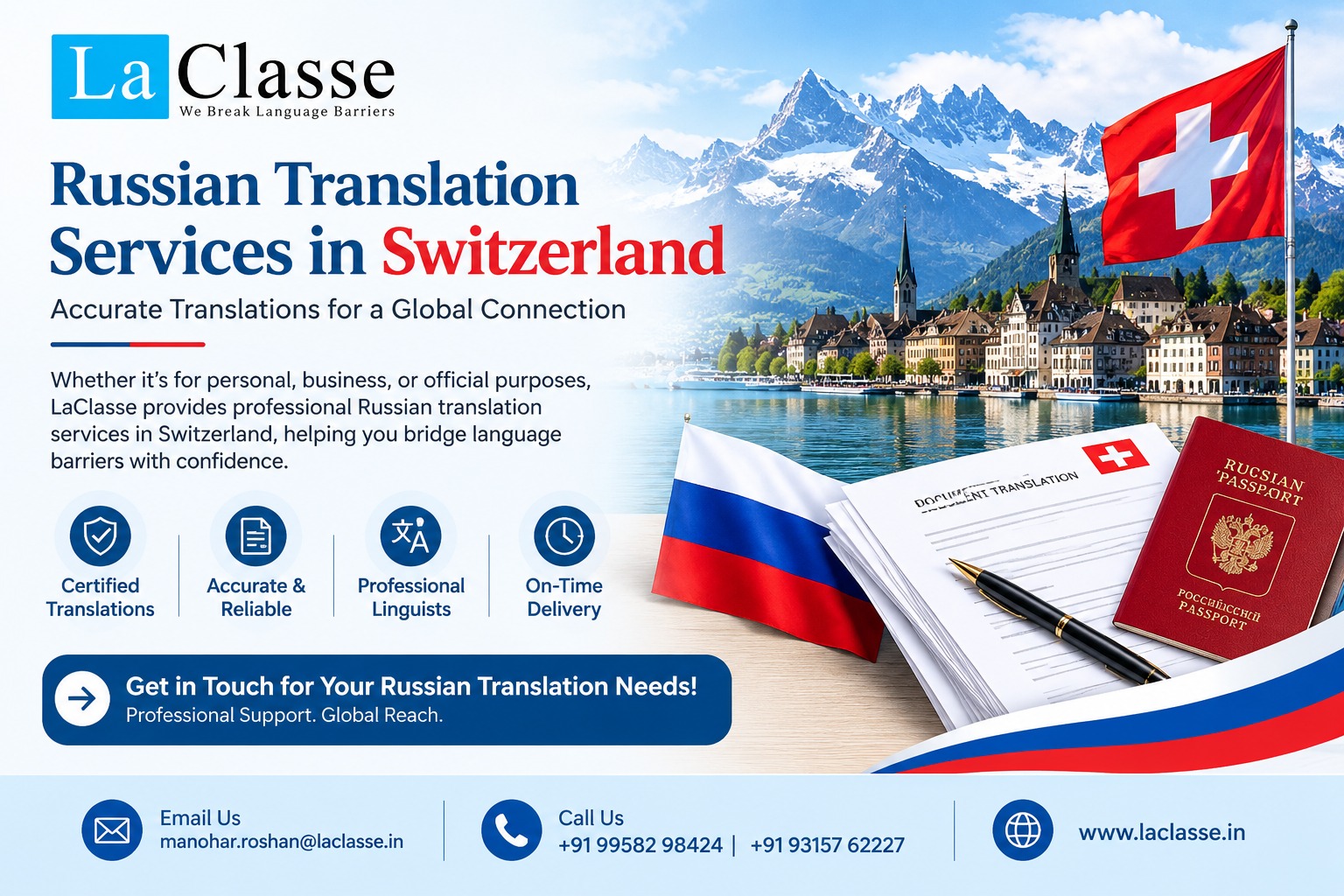
Switzerland is known for its international business environment, high-quality education, financial services, and multicultural communities. People from different countries live, work, study, and conduct business there, creating a need for accurate communication across languages. Russian is relevant for individuals and organisations dealing with Russian-speaking clients, academic institutions, business partners, and family members.
Finding suitable Russian translation services in Switzerland can make it easier to handle personal paperwork, professional communication, commercial agreements, and academic records. However, not every translation serves the same purpose. A document intended for general understanding may require a different approach from one submitted to a government office, university, employer, bank, or court.
Switzerland has four national languages: German, French, Italian, and Romansh. The language commonly used for official communication depends on the relevant authority and region. Russian is an additional language rather than a national official language, so people may need translations between Russian and the language accepted by the receiving organisation.
This guide explains how to choose a translator, which documents may require professional translation, what to consider before placing an order, and how translation needs can differ across Zurich, Geneva, Basel, Lausanne, Bern, and other Swiss locations.
Why Professional Russian Translation Matters in Switzerland
Translation involves more than replacing words in one language with words in another. The translator must understand context, sentence structure, terminology, document formatting, and the purpose of the final text.
For example, a Russian employment contract may contain terms relating to responsibilities, payment, confidentiality, and termination. A literal translation can make individual sentences understandable while still failing to communicate their intended meaning accurately. Professional translation aims to preserve both the meaning and the structure of the original document.
People searching for Russian translation services in Zurich may need assistance with business correspondence, academic applications, or personal certificates. Similarly, organisations looking for Russian translation services in Geneva may need support with international communication, agreements, reports, or documents for multilingual audiences.
The appropriate service depends on the intended use. Before selecting a translator, identify the source language, target language, document type, deadline, and the receiving organisation's requirements.
Understanding Different Types of Russian Translation
General document translation
General translation is suitable for letters, personal correspondence, informational documents, website content, and other materials that do not necessarily require formal certification.
Someone looking for Russian document translation in Switzerland should explain whether the translated document is intended for personal reference or official submission. This distinction helps the service provider recommend an appropriate translation format.
Certified or officially accepted translation
Some institutions require a translation accompanied by a declaration, certification, signature, or other supporting formalities. The exact requirements depend on the receiving authority and the type of document.
A person searching for certified Russian translation services in Switzerland should not assume that every provider's certification will automatically be accepted everywhere. Ask the institution receiving the document what qualifications, declarations, or authentication steps it requires.
Legal translation
Legal translation involves materials such as contracts, court decisions, powers of attorney, affidavits, and other legal records. Such documents can contain terms whose meaning depends on the relevant legal system.
Professional Russian legal translation services in Switzerland should prioritise accuracy, consistent terminology, confidentiality, and faithful representation of the source document. A translator should not change the meaning of a clause simply to make the translated wording sound more natural.
Technical translation
Technical content may include operating instructions, engineering specifications, product documentation, safety information, and technical reports. Translators need to understand the subject matter as well as the language.
Businesses considering Russian technical translation services in Switzerland should ask whether the translator has experience with the relevant industry and its terminology.
Business and commercial translation
Companies may require Russian versions of proposals, company profiles, financial reports, presentations, product catalogues, and customer communications.
Reliable Russian business translation services in Switzerland help organisations communicate clearly with Russian-speaking audiences while maintaining a consistent professional tone. Brand names, measurements, financial figures, dates, and contractual details should be checked carefully before delivery.
Russian Translation for Personal and Official Documents
Personal documents often contain names, dates, identification numbers, official stamps, and other details that must remain consistent with the original.
Birth and marriage certificates
Birth certificates may be needed for family-related procedures, registrations, applications, or other administrative matters. Marriage certificates may be required when a person needs to demonstrate marital status or submit records to an institution.
People searching for Russian birth certificate translation in Switzerland or Russian marriage certificate translation in Switzerland should confirm the required target language and whether the authority needs a certified or otherwise formally accepted translation.
Educational records
Students and professionals may need to submit diplomas, degree certificates, academic transcripts, mark sheets, course descriptions, or training certificates.
A request for Russian diploma translation in Switzerland may involve translating the qualification title, institution name, subjects, grades, dates, and explanatory notes. The translation should not imply that a qualification has been recognised when the relevant educational authority has not made that decision.
Immigration and residence documents
Applications involving residence, family reunification, or other migration procedures may require supporting documents in an accepted language. Requirements can differ according to the application type and competent cantonal authority. Switzerland's migration authorities provide information about language requirements and related procedures.
Before ordering Russian immigration document translation in Switzerland, applicants should check the current document checklist for their specific procedure. A translation alone does not guarantee approval of an application.
Police clearance and civil records
Police clearance certificates, civil-status records, and other official documents may be required for employment, immigration, education, or administrative purposes.
For Russian police clearance certificate translation services in Switzerland, check whether the recipient requires a translation of the entire certificate, including stamps, annotations, and supplementary pages. Confirm whether the original document must also be submitted.
Medical and insurance documents
Medical reports, prescriptions, insurance correspondence, and hospital records can contain specialised terminology. Accuracy is particularly important when the information affects treatment decisions, insurance claims, or communication between healthcare professionals.
When arranging Russian medical translation services in Switzerland, ask about the translator's relevant experience and how confidential records will be handled. Medical translation should preserve measurements, medication names, dates, and clinical details without adding unsupported interpretations.
Translation Needs Across Major Swiss Cities
Switzerland's different language regions mean that the correct target language may vary even when the source document is the same. A document submitted in a German-speaking canton may have different language requirements from one intended for a French-speaking or Italian-speaking authority.
Zurich
Russian translation services in Zurich may be relevant to international companies, students, professionals, families, and residents dealing with documents in Russian.
Common requests can include business contracts, academic records, personal certificates, employment documents, and website content. Before submitting a translation to a university, employer, bank, or public office, confirm whether German, English, or another language is accepted.
For individuals living in nearby Winterthur, Uster, Dietikon, or other parts of the canton, remote translation services can be a practical option when the provider accepts digital documents.
Geneva
Geneva has an international professional environment, and French is particularly important for many local administrative interactions. People searching for Russian translation services in Geneva may require personal-document translation, business correspondence, international agreements, or multilingual publications.
The target language should be selected according to the recipient's instructions rather than the city alone. French may be appropriate for one submission, while English or German may be requested for another.
Residents and businesses in Carouge, Vernier, Lancy, and nearby communities can also look for remote providers offering suitable language combinations.
Basel
Basel is an important location for business, research, and international professional activity. Requests for Russian translation services in Basel may involve technical manuals, employment records, research documents, commercial contracts, and academic materials.
Where documents contain specialised terminology, choose a translator who understands the relevant field. For submissions to local institutions, confirm whether Standard German is required instead of another form of German-language content.
People in Allschwil, Binningen, and surrounding areas can consider online services if physical document submission is not necessary.
Lausanne
French is widely used in Lausanne and the surrounding region. Individuals looking for Russian translation services in Lausanne may need help with educational certificates, personal paperwork, professional applications, or commercial materials.
Students should check the language requirements of their chosen institution before translating academic records. Businesses should also consider whether their content is intended for a French-speaking audience, an international audience, or both.
Nearby locations such as Renens, Pully, and Prilly may also be served by providers that accept digital files.
Bern
Bern has a multilingual context, and the relevant language can depend on the institution and location. Russian translation services in Bern may support personal, academic, administrative, and business-related translation requests.
Before submitting official documents, verify the receiving authority's preferred language and formal requirements. Do not assume that an English translation will be accepted simply because the applicant is communicating internationally.
Residents in Köniz, Ostermundigen, and other nearby communities can compare remote and local service options according to their needs.
Lugano
Lugano is situated in the Italian-speaking canton of Ticino. People looking for Russian translation services in Lugano may need Russian-to-Italian translation services in Switzerland for local communication, business paperwork, personal documents, or institutional submissions.
A translator familiar with Italian administrative terminology can help preserve the meaning of official and commercial content. The recipient's requirements should still determine whether any certification or additional formalities are necessary.
Other nearby and regional locations
Translation requirements are not limited to Switzerland's largest cities. Residents and businesses in Fribourg, Neuchâtel, Sion, Chur, St. Gallen, Lucerne, and other communities may also need Russian-language assistance.
For example, Russian translation services in Fribourg may involve choosing between French and German depending on the recipient. Russian translation services in Neuchâtel may be useful when French-language documentation is required, while Russian translation services in St. Gallen may involve German-language submissions.
The most effective approach is to identify the receiving institution first and then choose a provider that can deliver the required language combination and document format.
How to Choose a Reliable Russian Translation Provider
Selecting a translation provider should involve more than comparing the lowest advertised price. The quality of the final document, the provider's subject knowledge, communication, and ability to meet the recipient's requirements all matter.
Check language expertise
Ask whether the translator works professionally with the required language pair, such as Russian to German, Russian to French, Russian to Italian, or Russian to English.
A provider may offer several languages but have different levels of expertise across them. For legal, medical, or technical documents, relevant subject knowledge is especially important.
Confirm the required certification.
Before ordering a certified translation, request clarification about what the provider supplies. Ask whether the service includes a signed declaration, translator details, a stamp, notarisation, or another procedure if required.
These options are not interchangeable. A notarised signature does not necessarily confirm the accuracy of the translation, and an ordinary translation may not meet the requirements for an official application.
Ask about confidentiality
Documents can contain personal addresses, passport details, financial information, medical history, or commercially sensitive data.
A responsible provider should explain how documents are received, stored, accessed, and deleted. Use secure submission methods where available and share only the information necessary for the task.
Review turnaround times
Urgent translation may be possible for short documents, but complex contracts and lengthy reports require more time for translation and review.
When requesting Russian translation services near or in another Swiss city, provide the number of pages, document format, language direction, and deadline. Ask whether proofreading, formatting, and any required certification are included in the quoted delivery time.
Compare quotations fairly
A useful quotation should explain the charging method and any additional fees. Costs can depend on word count, document complexity, formatting, language pair, urgency, and certification requirements.
Rather than selecting a provider based on an unusually low headline price, compare what each quotation includes and whether the service matches the receiving institution's expectations.
The Translation Process: From Document Submission to Final Delivery
Understanding the process can reduce delays and help you prepare the right files.
Step 1: Identify the purpose. Decide whether the document is intended for personal understanding, business communication, education, immigration, legal use, or another purpose.
Step 2: Confirm the target language. Determine whether the receiving organisation needs German, French, Italian, English, or another language.
Step 3: Prepare the source document. Provide clear scans or readable digital files. Include relevant pages, stamps, signatures, and supplementary sheets when they are required.
Step 4: Request a quotation. Share the document type, approximate length, deadline, and certification requirements. Ask about additional charges before confirming the order.
Step 5: Translation and review. The translator prepares the text and checks names, dates, terminology, figures, and formatting against the original.
Step 6: Verify the delivered file. Review spelling of personal names, document numbers, dates, and any specific instructions provided by the receiving organisation.
Step 7: Complete additional formalities if necessary. Some documents may require notarisation, authentication, legalisation, or an apostille, depending on their origin and intended use.
An apostille authenticates the origin of a public document; it is not a substitute for translating the document itself. Whether an apostille or another form of authentication is needed depends on the countries and authorities involved.
Pros and Cons of Professional Russian Translation
Pros
- Improved accuracy: A qualified translator can preserve context, terminology, and important details.
- Clearer communication: Professionally translated content can help individuals and businesses communicate with Russian-speaking audiences.
- Better document preparation: Consistent formatting and terminology can make documents easier to review.
- Specialist support: Experienced translators may be able to handle legal, academic, technical, or medical material.
- Convenience: Remote services can reduce the need to travel for routine translation requests.
Cons
- Additional expense: Professional translation costs more than relying on free automatic tools.
- Variable turnaround: Long or specialised documents may require several working days or longer.
- Certification limitations: A translation provider cannot guarantee acceptance by every institution.
- Extra formalities: Some submissions require authentication or other steps beyond translation.
- Review may be necessary: Poor scans, unclear handwriting, inconsistent spellings, or missing pages can delay completion.
These limitations can be managed by clarifying requirements in advance and allowing enough time for the entire submission process.
Common Mistakes to Avoid
One common mistake is ordering a translation before checking the receiving authority's requirements. This can lead to paying for the wrong language or an unsuitable certification format.
Another mistake is submitting incomplete scans. If a certificate includes information on the reverse side, an official stamp, or an additional page, omitting it can result in an incomplete translation.
Applicants should also avoid changing the spelling of names between documents without checking the appropriate transliteration. Russian names can be represented in Latin characters in different ways. Where a passport or another official identity document provides a recognised spelling, inform the translator so the spelling can be handled consistently.
Finally, do not rely exclusively on machine translation for contracts, medical records, or documents submitted for official purposes. Automated tools can assist with understanding general content, but they may mishandle legal expressions, abbreviations, or context-specific terminology.
Frequently Asked Questions
1. How can I find Russian translation services in Switzerland?
Start by identifying the document type, target language, intended recipient, and whether certification is required. Compare providers based on language expertise, relevant experience, confidentiality practices, pricing, and delivery time.
2. Can Russian documents be translated into German or French?
Yes. Russian documents can be translated into German, French, Italian, English, and other languages by providers offering the relevant language pair. The correct choice depends on the recipient's requirements.
3. Are certified Russian translations accepted by all Swiss authorities?
Not automatically. Acceptance depends on the institution, procedure, document type, and applicable rules. Confirm the requirements directly with the receiving authority before placing an order.
4. Can I request a translation online?
Many providers accept scanned documents and deliver digital translations. However, an institution may require an original document, a physical signed translation, or additional formalities. Check this before ordering.
5. Which documents can be translated from Russian?
Common examples include birth and marriage certificates, diplomas, academic transcripts, contracts, police clearance certificates, employment records, medical reports, and business documents.
6. How much do Russian translation services cost in Switzerland?
Prices vary according to word count, document complexity, language pair, urgency, formatting, and certification requirements. Request a quotation based on your actual document instead of relying on a general estimate.
7. Do I need an apostille after translating a Russian document?
Not in every case. Translation procedures serve different purposes. Ask the receiving authority whether the original document needs authentication and whether any specific translation formalities apply.
8. Can businesses use Russian translation for websites and marketing?
Yes. Websites, product descriptions, brochures, presentations, and customer communications can be translated for Russian-speaking audiences. A professional review can help maintain consistent terminology and a suitable brand tone.
Conclusion
Choosing suitable Russian translation services in Switzerland starts with understanding the document's purpose and the receiving organisation's requirements. Whether you live in Zurich, Geneva, Basel, Lausanne, Bern, Lugano, or a smaller Swiss community, the key considerations remain accuracy, language expertise, confidentiality, transparent pricing, and appropriate documentation.
For personal certificates, academic records, legal papers, or business materials, explain your requirements clearly before ordering. Confirm the target language, ask whether certification is necessary, and allow time for any additional formalities. A carefully selected translation provider can help make cross-language communication clearer and the document preparation process more organised.
About La Classe Translation
La Classe Translation Pvt. Ltd. provides language services including Persian translation, document translation, localisation, interpretation, transcription, proofreading, and certified translation. Its Persian translation service page discusses support for personal records, educational certificates, legal documents, business content, technical materials, and websites.
For information about available services, visit the official page: https://www.laclasse.in/persian-translation-services
Contact La Classe Translation Pvt. Ltd.
Address: F-126, Aditya Arcade, Preet Vihar, New Delhi – 110092, India
Email: manohar.roshan@laclasse.in
Phone: +91-9958298424 / +91-9315762227
Contact the team with the source document, target language, intended use, and deadline to discuss the requirements of your Persian translation project.