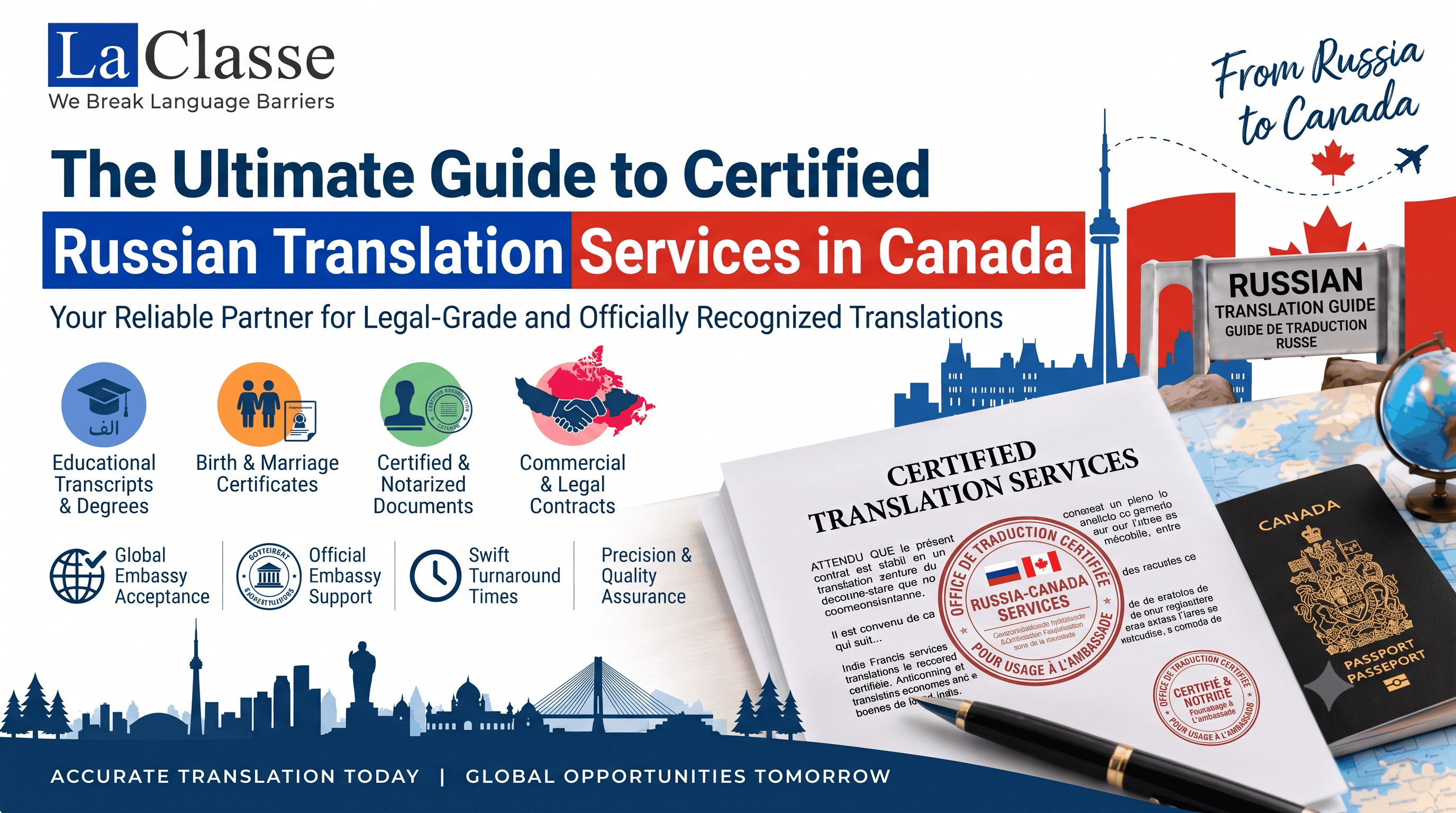
In an increasingly connected world, communication across languages plays an essential role in education, immigration, international business, legal documentation, and personal affairs. As connections between Russia and Canada continue to create opportunities for individuals and organizations, the demand for accurate Russian Translation Services in Canada has become important for people who need to communicate clearly across language barriers.
Whether you are preparing documents for immigration, applying to a Canadian university, expanding your business, translating a birth certificate, or managing international legal paperwork, choosing the right translation provider can make the process more straightforward. Professional Russian Translation Services in Canada help ensure that documents are translated accurately, presented professionally, and prepared according to the requirements of the organisation receiving them.
Canada is home to diverse communities, international students, skilled professionals, entrepreneurs, and families with connections to different parts of the world. Major cities such as Toronto, Vancouver, Montreal, Calgary, Ottawa, Edmonton, Winnipeg, and Halifax offer a variety of opportunities for people who require multilingual communication.
La Classe Translation provides language-related assistance for individuals and businesses seeking dependable translation solutions. Comprehending your documentation specifications, intended language, objective, and submission protocols represents the foundational step in identifying a suitable service provider.
This comprehensive guide explains the different types of Russian Translation Services, the importance of accuracy, document requirements, translation procedures, city-specific considerations, and the factors to evaluate before choosing a translation agency.
Understanding Russian Translation Services in Canada
Russian is widely used in international business, education, research, cultural communication, and personal correspondence. Translating Russian documents into English or French can help individuals communicate with Canadian institutions, employers, educational organisations, and other service providers.
Russian Translation Services in Canada cover several types of documents, including personal certificates, educational records, employment documents, legal paperwork, technical manuals, business contracts, and official correspondence.
The specific requirements applicable to each document are contingent upon its designated purpose. A personal correspondence may necessitate solely an accurate translation, whereas an immigration petition or legal filing may mandate a particular certification, declaration, affidavit, or prescribed format.
For this reason, professional Russian translation involves more than replacing Russian words with English or French equivalents. It requires an understanding of terminology, context, names, dates, formatting, and the expectations of the receiving organisation.
A professional translator must preserve the original meaning while ensuring that the translated document reads naturally in the target language. Important details such as document numbers, official seals, signatures, handwritten notes, and institutional names should be handled carefully.
When selecting Russian to English Translation in Canada, customers should explain exactly where the translated document will be submitted. This information helps the provider identify the appropriate translation approach and highlight any requirements that need confirmation.
Why Is Professional Russian Translation Important?
Translation errors can create confusion, especially when documents contain personal information, legal terminology, academic qualifications, or financial details. Even a small spelling difference in a person's name may cause questions when the translated document is compared with a passport or another identity record.
Professional Russian Document Translation in Canada focuses on accuracy, consistency, and clarity. It also helps ensure that important information is not omitted when a document contains multiple pages, stamps, annotations, or specialised vocabulary.
Consider a student applying to a Canadian university with educational records issued in Russian. The receiving institution may require comprehension of course designations, grade assessments, credit allocations, academic timeframes, and the identification of the issuing institution. A clear translation helps the admissions team review the information more efficiently.
Similarly, an entrepreneur negotiating with a Russian-speaking supplier may need business agreements, product specifications, invoices, or corporate documents translated accurately. In these situations, consistent terminology is important because different interpretations may affect the understanding of commercial obligations.
Professional translation can also help families handling birth certificates, marriage records, name-change documents, and other personal paperwork.
The main benefit is reliable communication. While translation is a necessary step, it does not independently ensure that a document will be recognised or approved by governmental agencies, academic institutions, judicial bodies, employers, or comparable authorities. Acceptance depends on the receiving organisation's rules and the specific circumstances of the submission.
Types of Russian Translation Services Available in Canada
1. Certified Russian Translation Services
Certified Russian Translation Services in Canada are frequently requested for official paperwork. A certified translation generally includes a statement or certification confirming that the translation is complete and accurate, according to the applicable professional or institutional requirements.
The exact meaning of certification varies by jurisdiction and receiving organisation. Canadian institutions may have specific rules regarding the qualifications or membership of translators, while some overseas authorities may request additional documentation.
Before ordering a certified Russian translation, confirm whether the recipient requires a translator certified by a recognised provincial association, a particular certification statement, an affidavit, or notarization.
Do not assume that every translated document requires notarization. Likewise, do not assume that a standard translation will satisfy every official requirement.
2. Russian-to-English Translation
Russian to English Translation in Canada is useful when Russian-language documents must be reviewed by English-speaking institutions, companies, professionals, or individuals.
A quality-focused translator considers the document's context and purpose. For example, scholarly vocabulary ought to correspond to the particular educational framework in question, rather than depending upon a direct, literal translation of terminology.
3. English-to-Russian Translation
English to Russian Translation Services in Canada support businesses, educational organisations, researchers, and individuals communicating with Russian-speaking audiences.
These services may cover corporate websites, marketing material, user guides, business proposals, product descriptions, presentations, training resources, and personal documents.
Effective translation requires an understanding of the intended audience. A technical manual must prioritise precision, whereas marketing content may require adaptation to ensure the message resonates naturally and appropriately within the Russian context.
4. Russian-to-French Translation
French is especially important in Quebec and is one of Canada's official languages. Some organizations may require documents in French rather than English.
Russian-to-French translation in Canada can be relevant for academic records, personal certificates, commercial paperwork, and administrative documents.
French terminology and formatting conventions may differ from English-language equivalents. A translator should understand the intended use of the document and follow the receiving institution's requirements.
5. Legal Russian Translation
Legal Russian Translation in Canada may involve agreements, court records, powers of attorney, affidavits, legal notices, contracts, corporate records, and other documents containing legal terminology.
Legal translation requires particular attention to definitions, dates, names, clauses, references, and the relationship between different parts of a document.
A translator should not change the legal meaning of the source text to make it sound simpler. Where an expression has no direct equivalent, the translation must convey its meaning as accurately as possible.
Translation services do not replace legal advice. If a document has legal consequences, the customer should confirm its requirements with the relevant legal professional or receiving authority.
6. Russian Academic Translation
Students and researchers may require Russian Academic Translation in Canada when submitting academic records to universities, credential assessment organizations, scholarship providers, or employers.
Documents may include diplomas, degree certificates, transcripts, course descriptions, research abstracts, recommendation letters, and academic publications.
Academic translation must preserve the original information about qualifications, grades, subjects, institutions, and dates. Where educational systems differ, terminology should be selected carefully so the translation does not incorrectly imply that two qualifications are equivalent.
7. Russian Business Translation
International companies frequently exchange proposals, contracts, financial records, technical instructions, and corporate communications.
Russian Business Translation Services in Canada can help businesses communicate with Russian-speaking partners, customers, suppliers, and professional contacts.
The appropriate translation approach depends on the industry. Financial documents require consistent accounting terminology, while engineering documents may include measurements, specifications, and technical abbreviations.
A reliable translation workflow should include terminology review and checks for missing information, inconsistent names, and formatting errors.
Russian Translation Services for Immigration Documents
Immigration-related paperwork is one of the important reasons people seek professional translation assistance.
Immigration, Refugees and Citizenship Canada (IRCC) generally requires supporting documents to be in English or French. Documents in another language normally need an English or French translation and may require an affidavit and a certified copy of the original, depending on the translator's qualifications and the applicable instructions. Applicants should review the requirements for their particular application. Russian Immigration Translation in Canada should be arranged with attention to the relevant application checklist.
For example, a police certificate written in Russian may need to be accompanied by an acceptable English or French translation. The original document and translation should be submitted in the manner specified by the relevant immigration instructions.
Applicants should not rely on assumptions about whether a translation is acceptable. Requirements can differ according to the program, document type, and circumstances.
It is also important to remember that a translator cannot guarantee an immigration decision. Translation services address language requirements; they do not determine eligibility for a visa, permanent residence, work permit, or study permit.
Russian Translation for Personal Documents
Personal documents often contain details that must match official identity records exactly. This makes careful proofreading especially important.
Birth Certificates
A birth certificate may include a person's full name, date and place of birth, parents' details, registration information, and official stamps.
Russian Birth Certificate Translation in Canada should preserve these details accurately and maintain consistency with the spelling used in relevant identity documents.
Marriage Certificates
Marriage certificates may be required for family sponsorship, civil registration, administrative procedures, or personal records.
Russian Marriage Certificate Translation in Canada should include the names of the parties, date of marriage, registration details, and relevant official annotations.
Divorce Certificates and Court Records
Divorce records may contain legal terms, court references, dates, and decisions. Translators should reproduce the information faithfully without interpreting the legal consequences.
Police Certificates
Police certificates may be requested for immigration, employment, licensing, or other official purposes. The translation must accurately reflect the information on the original certificate.
Medical Records
Medical records may include diagnoses, treatment histories, laboratory findings, prescriptions, and clinical abbreviations.
Russian Medical Translation in Canada should be completed by someone familiar with the terminology relevant to the document. If a healthcare provider or institution has specific requirements, those should be confirmed before translation begins.
Russian Translation for Education and Employment
Canada attracts students and professionals from around the world. Individuals with Russian-language academic or employment records may need translations when applying for courses, jobs, professional recognition, or further study.
Academic Certificates and Transcripts
Russian Academic Translation Services in Canada may include diplomas, transcripts, course descriptions, certificates, and recommendation letters.
A transcript may contain subject names, grades, credit hours, examination results, and academic dates. Each element should be translated consistently, and unclear abbreviations should be investigated rather than guessed.
Employment Documents
Employment applications may require experience letters, job descriptions, training certificates, professional licences, or references from previous employers.
Russian Employment Document Translation in Canada helps employers understand an applicant's qualifications and work history.
Research and Technical Material
Researchers may need scientific articles, abstracts, laboratory reports, technical papers, and presentations translated between Russian and English.
Technical translation benefits from consistent terminology and subject-matter familiarity. When a document includes diagrams, tables, formulas, or abbreviations, the translator should ensure that the text remains aligned with the original.
Russian Business and Corporate Translation
Businesses working with international markets may need Russian-language communication for commercial negotiations, procurement, product distribution, research, and customer support.
For commercial documents, terminology consistency is especially important. If a particular product, company, service, or contractual term appears repeatedly, the same appropriate translation should generally be used throughout the document.
Marketing material requires a slightly different approach. A direct translation may preserve the words but fail to communicate the intended message naturally. Professional translators should consider tone, audience, cultural context, and the purpose of the content.
Major Canadian Cities for Russian Translation Services
Canada's large cities have different institutional, commercial, academic, and community needs. Online translation services can help customers access assistance even when they are not located near a translation office.
Toronto, Ontario
Toronto is a major destination for business, education, immigration, and international commerce. People may require Russian Translation Services in Toronto for academic records, immigration paperwork, employment documents, contracts, and personal certificates.
Vancouver, British Columbia
Vancouver has international business connections and educational institutions that may require translated documents. Russian Translation Services in Vancouver can support students, professionals, families, and companies dealing with Russian-language paperwork.
Montreal, Quebec
Montreal operates in a bilingual national environment with a particularly important French-language context. Russian Translation Services in Montreal may be useful when documents need to be prepared in French or English, depending on the receiving organisation's instructions.
Calgary, Alberta
Calgary has business, engineering, energy, education, and professional employment sectors. Russian Translation Services in Calgary can support technical documents, employment records, corporate paperwork, and personal certificates.
Ottawa, Ontario
Ottawa is Canada's capital and has government-related, educational, professional, and administrative institutions. Russian Translation Services in Ottawa may assist people preparing documents for official review, academic applications, or professional communication.
Edmonton, Alberta
Edmonton has universities, businesses, public institutions, and a diverse population. Russian Translation Services in Edmonton may include academic translations, legal documents, employment records, and business material.
Winnipeg, Manitoba
Winnipeg is an important centre for education, commerce, manufacturing, and community services. Russian Translation Services in Winnipeg can help individuals and organisations prepare Russian-language documents for English or French readers.
Halifax, Nova Scotia
Halifax has educational institutions, professional services, and international connections. Russian Translation Services in Halifax may be relevant for students, families, and businesses requiring accurate document translation.
Other Cities and Communities
Translation needs also arise in Mississauga, Brampton, Markham, Richmond, Surrey, Burnaby, North Vancouver, Quebec City, Saskatoon, Regina, Kitchener, Waterloo, Hamilton, London, and St. John's.
People searching for Russian Translation Services in Mississauga, Russian Translation Services in Brampton, or Russian Translation Services in Surrey should focus on the quality of the translation and the recipient's requirements rather than choosing a provider solely because of its location.
Online communication can make it possible to discuss documents, confirm requirements, and arrange delivery without travelling to a physical office.
How to Choose a Russian Translation Agency in Canada
Choosing a translation provider requires more than comparing prices. Customers should consider qualifications, experience, communication, confidentiality, quality assurance, and the requirements of the receiving organisation.
Check Relevant Experience
Ask whether the provider has experience with the type of document you need translated. Immigration records, academic transcripts, technical manuals, and legal agreements each require different terminology and attention.
Confirm Certification Requirements
Ask the receiving institution what it accepts. A certified translation, an affidavit, a notarized statement, and a certified copy are not interchangeable in every situation.
Review Accuracy Procedures
A professional workflow should include proofreading, consistency checks, and a review of names, dates, numbers, stamps, and document references.
Discuss Confidentiality
Documents may contain personal, financial, academic, or legal information. Ask how the provider receives, stores, processes, and delivers sensitive files.
Understand Pricing
Translation costs can depend on document length, language combination, technical complexity, formatting, certification, and turnaround time.
Request a quotation based on the actual document rather than relying exclusively on a generic per-page price.
Confirm Delivery Time
Urgent requests should be discussed before work begins. The provider should explain what can realistically be completed and whether certification or additional administrative steps may affect the schedule.
The Russian Translation Process at La Classe Translation
La Classe Translation aims to help customers understand their translation requirements and arrange suitable language services.
A clear process can reduce confusion and help customers prepare their documents more effectively.
Step 1: Share the document details. Explain the document type, source language, required target language, and intended use. This information helps establish the scope of the request.
Step 2: Confirm the recipient's rules. Identify whether the translated document is intended for an immigration application, university, employer, court, business, or another institution. Ask the recipient about any specific certification or formatting requirements.
Step 3: Obtain a quotation. The quotation should explain the expected scope, cost, and delivery time. Additional services should be identified before work begins.
Step 4: Complete the translation. The translation should preserve the original meaning and accurately reproduce important information.
Step 5: Review the translated document. Proofreading should focus on grammar, spelling, terminology, numbers, dates, names, and completeness.
Step 6: Arrange the required documentation. If certification, an affidavit, notarization, or another supporting item is required, confirm how it will be provided.
Step 7: Deliver and check the files. Customers should review the delivered translation and confirm that the file is complete and readable before submission.
This process helps make Russian Translation Services in Canada easier to understand and manage, particularly for customers handling multiple documents or several application requirements.
Why Choose La Classe Translation?
Selecting the right provider can make the translation process more organized. La Classe Translation focuses on helping customers identify their document needs and understand the available language-service options.
Document-Focused Assistance
Every document has a purpose. A university transcript, legal agreement, personal certificate, and technical report should not be treated as identical projects.
La Classe Translation can help customers explain the document type and clarify the intended use before the scope of work is confirmed.
Attention to Language Accuracy
Accurate translation requires consistent terminology, correct names and dates, and careful handling of information that appears in different parts of a document.
A structured review process helps reduce avoidable mistakes and improves readability.
Support for Different Document Categories
Customers may need assistance with educational records, business documents, personal certificates, legal paperwork, or general correspondence.
Identifying the correct category at the beginning makes it easier to discuss the expected format and requirements.
Clear Communication
Customers should understand the scope of a project, the expected delivery timeline, and any additional requirements before confirming an order.
Clear communication is especially useful when an institution has provided detailed submission instructions.
Service Across Locations
People seeking Russian Translation Services in Toronto, Vancouver, Montreal, Calgary, Ottawa, or other Canadian cities may prefer to coordinate their translation requests remotely.
Availability, language combinations, certification arrangements, and delivery options should be confirmed directly with La Classe Translation before placing an order.
A Practical Approach to Official Documents
La Classe Translation can help customers identify the information needed to discuss an official-document translation request. Customers remain responsible for confirming acceptance requirements with the authority receiving their documents.
No translation provider should promise guaranteed acceptance or a particular immigration outcome.
Factors That Affect Russian Translation Costs in Canada
Translation pricing varies according to the nature of the work. Understanding the main cost factors helps customers compare quotations more fairly.
Document length: A short certificate may require less work than a lengthy contract or academic transcript containing multiple pages.
Technical complexity: Legal, scientific, medical, and engineering documents may require specialised terminology and additional review.
Formatting requirements: Tables, seals, handwritten notes, stamps, and complex layouts can affect the time needed to prepare the final file.
Certification requirements: Certification statements, affidavits, notarization, or other administrative steps may involve additional work or third-party fees.
Urgency: Short deadlines can affect availability and pricing. Customers should confirm the feasibility of urgent requests before making plans.
Language direction: Russian-to-English, English-to-Russian, and Russian-to-French projects may involve different availability and expertise requirements.
The best approach is to request a quotation that clearly identifies what is included. Customers should also ask whether proofreading, certification, physical delivery, or formatting is included in the quoted amount.
Common Mistakes to Avoid When Ordering Translation
One common mistake is ordering a translation before checking the receiving institution's instructions. This can lead to avoidable revisions if the recipient requires a specific certification format or language.
Another mistake is providing incomplete scans. Cropped pages, unclear stamps, missing reverse sides, and unreadable handwritten information can make accurate translation difficult.
Customers should also avoid assuming that machine translation is sufficient for official documents. Automated tools may misunderstand legal expressions, names, abbreviations, or context-specific terminology.
A further mistake is treating certification and notarization as the same thing. The appropriate process depends on the document, jurisdiction, and recipient.
Finally, customers should avoid leaving translation until the last minute. Even a short document may require clarification, additional proofreading, or supporting paperwork.
Frequently Asked Questions About Russian Translation Services in Canada
1. What are Russian Translation Services in Canada?
These are professional language services that translate Russian documents and content into English, French, or another requested language. They may cover personal certificates, immigration documents, academic records, legal paperwork, business material, and technical content.
2. Do I need certified Russian translation for immigration?
It depends on the application and the receiving authority's requirements. IRCC generally requires documents in English or French and has specific rules for translations, affidavits, and copies of originals. Review the instructions for your particular application before ordering. 【turn576859search1】
3. Can Russian documents be translated into French?
Yes. Russian-to-French translation may be appropriate when a receiving organization requires French-language documentation. Confirm the accepted format and certification rules before submitting the translation.
4. Which Russian documents can be translated?
Depending on service availability, documents may include birth certificates, marriage certificates, police certificates, academic transcripts, diplomas, contracts, financial records, medical reports, and business documents.
5. How much do Russian Translation Services cost in Canada?
The price depends on document length, complexity, language direction, formatting, certification, and urgency. Share the document details with the provider to receive a quotation.
6. How long does Russian translation take?
Turnaround depends on the number of pages, document quality, terminology, review requirements, and any certification arrangements. Ask the provider to confirm the expected timeline for your specific request.
7. Can I order Russian translation online?
Many translation requests can be coordinated online by sharing readable document scans and confirming the project details. Whether original documents or physical delivery are required depends on the receiving institution and the service being ordered.
8. Are notarised and certified translations the same?
No. Certification generally relates to the translator's declaration or professional status, while notarization involves an authorized notary performing a specific legal or administrative function. The exact requirements depend on the recipient and jurisdiction.
9. Can I use a translated Russian birth certificate for an official application?
A translated birth certificate may be used when the relevant authority accepts the translation and accompanying documents. Confirm its rules for certification, supporting copies, and submission format.
10. Does La Classe Translation provide Russian translation assistance for different Canadian cities?
You can contact La Classe Translation to discuss your location, document type, language combination, and delivery requirements. Confirm service availability and any certification arrangements before placing an order.
11. Can Russian academic records be translated for Canadian universities?
Academic records can be translated, but universities may have specific requirements concerning certified translations, original documents, sealed transcripts, or direct submissions. Check the university's instructions before ordering.
12. Is Russian legal translation suitable for contracts?
Professional legal translation can help communicate the meaning of contracts and legal records across languages. For documents with legal consequences, consult the appropriate legal professional about translation and execution requirements.
13. Do I need to translate every stamp on a Russian document?
Not every institution follows identical rules. Stamps, seals, handwritten annotations, and other markings may need to be translated, particularly for official submissions. Confirm the recipient's requirements and provide complete document scans.
14. Can a translation guarantee immigration approval?
No. Translation addresses language and documentation needs, but immigration decisions depend on eligibility, evidence, application requirements, and the decision-making authority.
15. How do I begin a Russian translation request?
Identify the document, target language, intended recipient, and deadline. Then share readable document details with the provider and confirm the required certification format before approving the quotation.
Conclusion: Finding the Right Russian Translation Services in Canada
Accurate translation supports clear communication across education, immigration, business, legal matters, and personal documentation. Whether you need a birth certificate translated, an academic transcript prepared for university review, a contract translated for international business, or Russian-language records prepared for an official application, the process should begin with a clear understanding of the recipient's requirements.
When comparing Russian Translation Services in Canada, consider language accuracy, relevant experience, proofreading, confidentiality, certification requirements, pricing, and turnaround time.
People in Toronto, Vancouver, Montreal, Calgary, Ottawa, Edmonton, Winnipeg, Halifax, and other Canadian cities can explore suitable translation arrangements according to their document needs and location.
La Classe Translation can be contacted to discuss your translation requirements, clarify the scope of work, and request a quotation. Before submitting any translated document, verify the applicable instructions with the organisation that will receive it.
Contact La Classe Translation Pvt. Ltd.
La Classe Translation Pvt. Ltd.
Office: F-126, Aditya Arcade, Preet Vihar, New Delhi – 110092, India
Phone/WhatsApp: +91-9958298424
Additional contact: +91-9315762227
Email: manohar.roshan@laclasse.in
Website: https://www.laclasse.in/
Contact the team with your document type, target language, intended use, and required deadline to discuss the next steps for your translation request.