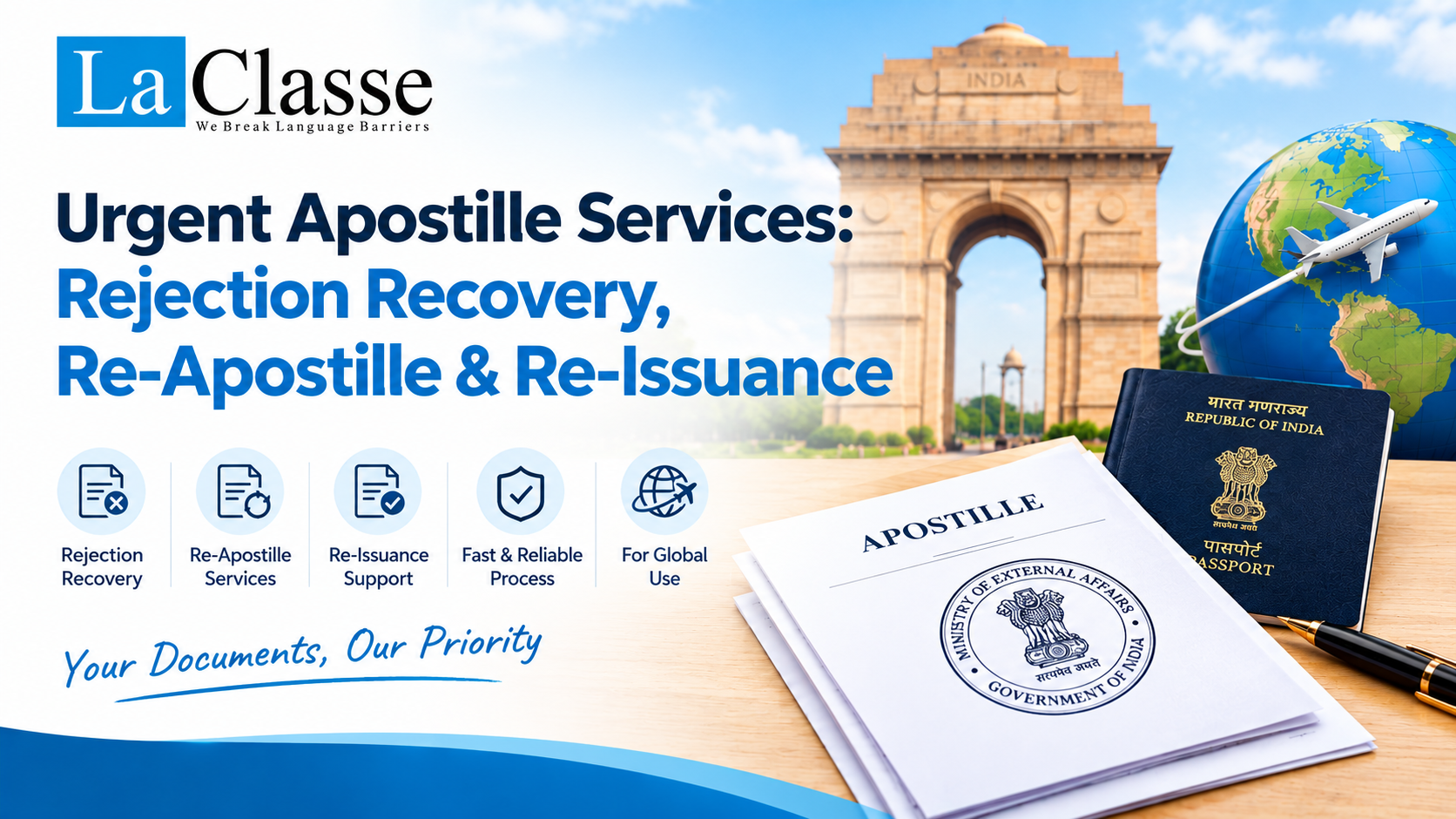
International documentation can become time-sensitive when a person has an upcoming flight, university admission, overseas job, immigration appointment, marriage-related requirement, or business submission. The situation becomes more complicated when a document is rejected, an apostille is lost, or the original apostille is damaged.
In such situations, applicants may search for an urgent apostille service in India, emergency apostille service, or professional assistance for completing the required authentication procedure.
However, urgent processing does not necessarily mean that an apostille can always be issued immediately. Some documents may need verification, pre-authentication, or confirmation from the issuing authority before they can reach the apostille stage. The procedure can therefore vary according to the document, issuing authority, destination country, and purpose of use.
This guide explains important aspects of apostille services in India, including rejected applications, re-apostille requirements, apostille verification, lost stickers, damaged apostilles, and urgent document requirements.
What Is an Apostille?
An apostille is an official form of authentication used for eligible public documents that are intended for use in another country covered by the Hague Apostille Convention.
The authentication confirms the origin of the public document, including the relevant signature, seal, or authority connected with its issuance. It does not confirm the actual contents of the document.
Depending on the purpose, documents such as educational certificates, birth certificates, marriage certificates, affidavits, commercial papers, and other public records may require authentication before being accepted abroad.
Whether a document requires an apostille depends on factors such as the destination country, document category, issuing authority, and requirements of the organisation receiving it. Applicants should therefore confirm the exact requirement with the relevant university, employer, embassy, immigration authority, government department, or other receiving organisation.
Why Do Applicants Need an Urgent Apostille?
A document requirement can become urgent without much notice. A student may suddenly be asked to submit an apostilled degree for admission. An overseas employer may request authenticated educational documents before joining. Similarly, an immigration application may require additional documentation shortly before an appointment.
These situations can lead people to search for urgent apostille, fast apostille service, express apostille service, or last-minute apostille service.
It is important to understand what an urgent service actually covers. A private provider may assist with document collection, checking, submission, coordination, tracking, or delivery. This does not automatically mean that the government authority will complete the apostille within a few hours.
The MEA Citizen’s Charter states that apostille is usually completed within seven working days after receipt in MEA. Therefore, applicants looking for a 24-hour apostille service should ask whether the quoted timeline refers to collection and submission assistance or actual government processing.
Apostille Requirements Before a Last-Minute Flight
When travel is approaching, applicants should first confirm exactly what the receiving organisation wants.
Before submitting a document for an apostille before a flight, check whether:
- The correct document has been selected.
- The destination country accepts an apostille.
- Pre-authentication is required.
- Verification from the issuing authority is necessary.
- The original document is needed.
- A translation is required.
- There is a fixed submission deadline.
- Electronic verification is accepted by the receiving organisation.
The e-Sanad system also supports online verification and authentication for eligible documents available through integrated digital repositories. Its applicability depends on the document and the relevant digital records.
Therefore, an urgent case should be evaluated according to the specific document instead of assuming that every document follows an identical procedure.
What If the Flight Is Only a Few Days Away?
Applicants with very little time should collect the original document and supporting papers and check whether any required verification or pre-authentication has already been completed.
If a preliminary step is still pending, the delay may happen before the document reaches the apostille stage.
An urgent MEA apostille service in India can assist with understanding the applicable document route, checking basic requirements, coordinating submission, and tracking the process. Applicants should nevertheless ask for a realistic timeline rather than relying only on a same-day promise.
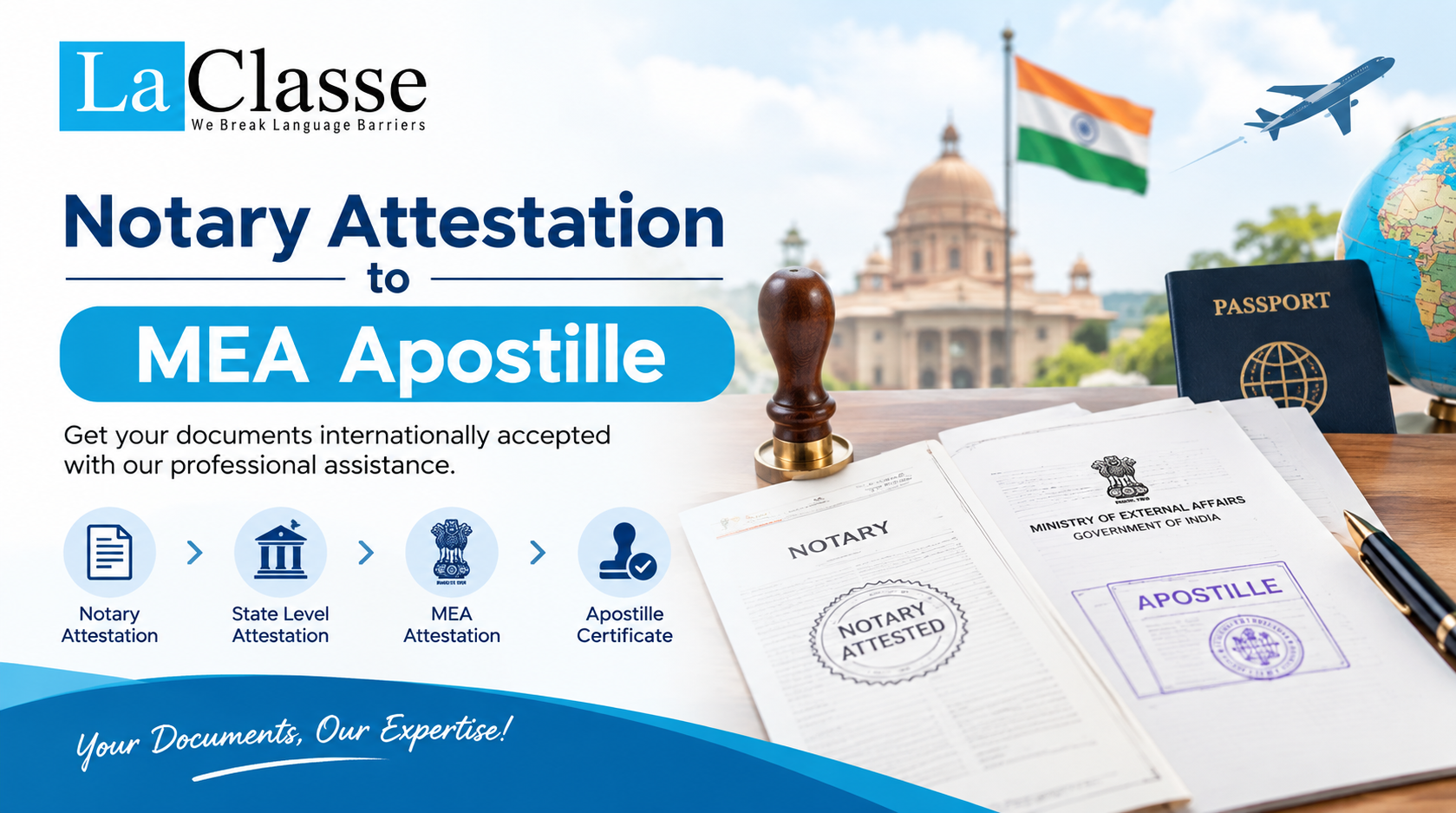
Apostille vs Attestation
Although the terms apostille and attestation are sometimes used interchangeably, they represent different authentication routes.
An apostille is generally used for documents intended for countries covered by the Hague Apostille Convention. Where an apostille is not applicable, normal attestation or another legalization process may be required.
Choosing the incorrect route can result in additional processing and delays. Before applying for an apostille in India, applicants should therefore confirm the destination country's document requirements.
What Happens When an Apostille Application Is Rejected?
An apostille’s rejected status can create additional pressure when an admission, employment, visa, or travel deadline is close.
Instead of immediately submitting the same document again, applicants should first determine why it was returned or rejected. Possible issues may involve document verification, pre-authentication, document information, issuing authority requirements, or another applicable condition.
A rejected application does not necessarily mean that the underlying document itself is invalid. It indicates that the document or authentication process did not meet the requirements at that particular stage.
For searches such as apostille rejected what to do, MEA apostille rejected, or apostille rejection reasons, the practical approach is to:
- Check the rejection or return information.
- Find the reason for the issue.
- Confirm whether the document requires correction.
- Review verification requirements.
- Check whether fresh pre-authentication is needed.
- Correct or replace the document where necessary.
- Submit it again through the applicable route.
When Is Re-Verification Required?
There is no single reason why a document may require apostille re-verification. The requirement depends on the document and its authentication history.
Verification may become necessary when the authenticity of the document or issuing authority cannot be established through the required process, or when the appropriate pre-authentication has not been completed.
For documents handled through the e-Sanad process, verification with the relevant document-issuing authority forms part of the authentication procedure.
Re-verification should therefore be understood as part of establishing document authenticity rather than simply obtaining another stamp.
What Is Re-Apostille?
The phrase re-apostille is commonly used when an applicant believes another apostille is required after a previous problem.
However, different situations need to be distinguished. For example, a document may have been rejected before apostille issuance, may contain incorrect information, may have been replaced, or may already have an apostille that has been damaged or needs verification.
These cases do not necessarily require the same solution.
Someone searching for re-apostille India should first determine whether the actual requirement is a new apostille, document correction, verification, replacement, or another authentication step.
What Is MEA Re-Apostille?
MEA re-apostille is another term frequently used when an applicant needs to submit a document again.
The correct process depends on what caused the earlier problem. If the underlying verification was incomplete, requesting another apostille without addressing that issue may not solve the problem.
In some cases, the document may need correction or re-authentication before another submission.
The process can therefore be understood as:
Identify the issue → resolve the document or authentication problem → complete the required verification → submit again for the applicable apostille process.
The exact procedure should be checked according to the individual document.
Lost Apostille Sticker: What Should You Do?
An apostille may be attached directly to a public document or to an attached page known as an allonge.
If an apostille sticker is lost, applicants should not assume that printing a photograph or photocopy of the sticker creates an official replacement.
The e-Sanad system provides an electronic register that can be used for verification of apostille-related information.
The appropriate next step may depend on whether the original document is available, whether apostille reference details exist, whether the apostille can be verified, and whether the receiving organisation requires fresh authentication.
If the underlying document has also been lost, obtaining a new document from the issuing authority may be necessary.
Therefore, lost apostille certificate cases should be assessed individually.
What If an Apostille Is Damaged?
A damaged apostille sticker can create a different issue from a lost apostille. It may be torn, faded, partially detached, exposed to moisture, or difficult to read.
Applicants should avoid repairing, reproducing, covering, or manually changing the apostille.
Instead, the original document should be preserved in its existing condition while the appropriate verification or re-issuance procedure is determined.
For a damaged apostille certificate, the key concern is whether the apostille and its information can still be properly identified and verified.
How Does Apostille Verification Work?
The purpose of an apostille is to establish the origin of an eligible public document.
An apostille verification facility is available through the e-Sanad electronic register, allowing relevant apostille information to be checked.
An apostille should not be judged only by its appearance. Apostilles issued by competent authorities can differ in design, size, colour, and other visual characteristics.
If a university, employer, immigration authority, or other organisation needs confirmation, the appropriate official verification mechanism should be used.
What Is e-Sanad Apostille?
e-Sanad apostille processing forms part of the Ministry of External Affairs' digital approach to document verification and authentication.
For eligible documents available through integrated digital repositories, the system can facilitate online verification and authentication. The general process can involve registration, submission of document information, payment of applicable fees, verification by the relevant issuing authority, and subsequent processing.
However, e-Sanad does not mean that every document can automatically be processed through the same online route. Eligibility depends on the availability of the required digital repository and applicable verification conditions.
Documents That May Need Apostille
There is no universal document list because requirements depend on the destination country and purpose.
Educational Documents
A degree certificate apostille may be required for overseas education, employment, professional registration, or related purposes. Documents can include degrees, diplomas, school certificates, transcripts, and other academic records.
Personal Documents
A birth certificate apostille service in India or marriage certificate apostille may be requested for immigration, family, marriage, residency, or administrative procedures abroad.
Police Documents
A PCC apostille or authentication of a Police Clearance Certificate may be required for certain immigration, employment, residency, or visa-related purposes.
Commercial Documents
Businesses involved in international transactions may need authentication for specific commercial or corporate documents. The exact requirement depends on the receiving jurisdiction and document type.
How Long Does MEA Apostille Take?
Processing time becomes particularly important when there is an approaching flight, visa appointment, university deadline, or employment joining date.
The MEA Citizen's Charter states that apostille is usually completed within seven working days after receipt in MEA.
However, the complete process can take longer if the document requires state-level authentication, issuing-authority verification, correction, replacement, courier movement, or additional documentation.
Therefore, applicants searching for urgent apostille service in India should consider the entire authentication journey rather than looking only at the final MEA processing stage.
What Should You Keep Ready?
Before approaching an apostille agency in India, applicants should keep the relevant information available, including:
- Original document, where required.
- Identification or passport details.
- Issuing authority information.
- Destination country.
- Receiving organisation.
- Purpose of document use.
- Previous pre-authentication details.
- Rejection or return information.
- Apostille reference details, where applicable.
- Actual admission, visa, joining, submission, or travel deadline.
Complete information can make it easier to identify whether the issue concerns the document itself or its authentication route.
Choosing an Emergency Apostille Service
When considering an emergency apostille provider, applicants should understand what the service actually includes.
Ask about the processing authority, verification requirements, pre-authentication, required documents, realistic timeline, submission procedure, rejection handling, apostille verification, lost or damaged apostille support, and applicable government and service charges.
An express apostille service may provide logistical and document-handling assistance, but private expedited assistance should not be confused with guaranteed government processing time.
Apostille, Re-Apostille and Verification
An apostille certificate authenticates an eligible public document for applicable international use.
Re-apostille generally refers to obtaining another apostille where a fresh authentication is actually required.
Verification is the process of checking whether the document or apostille can be authenticated through the relevant authority or official register.
For example, when a foreign university only wants to confirm an existing apostille, apostille certificate verification may be relevant instead of obtaining another apostille.
Frequently Asked Questions
Can I get an apostille urgently?
Private providers may offer expedited collection, submission, tracking, or delivery assistance. Government processing remains subject to the applicable procedure and timeline.
Can I get an apostille in 24 hours?
A provider may offer expedited assistance, but a 24-hour apostille service in India should not automatically be understood as a guaranteed 24-hour MEA processing period.
What should I do if my apostille is rejected?
Identify the rejection reason first. Depending on the issue, correction, verification, fresh pre-authentication, replacement, or resubmission may be required.
Can a rejected document be re-apostilled?
It depends on why the document was rejected. The underlying issue should be resolved before another submission.
How can I verify an apostille?
The e-Sanad electronic register provides a mechanism for verifying relevant apostille information.
What if I lose my apostille sticker?
Do not recreate it yourself. Preserve the original document and available reference information and determine whether verification or fresh authentication is required.
Is apostille the same as attestation?
No. An Apostille is associated with the Hague Apostille Convention, while attestation can apply where an apostille is not applicable.
Does every document need an apostille?
No. The requirement depends on the document, destination country, purpose, and receiving organisation.
Can every document use e-Sanad?
Not necessarily. Eligibility depends on the availability of the required integrated digital repository and applicable verification conditions.
Final Thoughts
Urgent document requirements can become difficult when deadlines are close, particularly when an apostille has been rejected, lost, or damaged.
The practical approach is to identify the exact document requirement first, confirm the destination country's rules, check whether pre-authentication or verification is necessary, and understand the applicable government timeline.
If an application has been rejected, the reason should be identified before another submission. If an apostille is lost or damaged, the original document and available reference information should be preserved while the appropriate verification or re-issuance route is determined.
The purpose of an urgent apostille service is not simply speed. Proper document assistance can help applicants understand the applicable authentication route, identify documentation issues, coordinate submission, and work within a realistic timeframe.
Contact La Classe Translation
If you need assistance with document authentication for overseas education, employment, immigration, or visa purposes, La Classe Translation can help you understand the applicable process. Our team assists with HRD attestation services, State HRD verification, Home Department authentication, GAD attestation services, and related document requirements.
Before starting, applicants can share details about their document, issuing authority, destination country, and purpose of submission so the applicable process can be reviewed. Whether you are preparing educational, personal, school, or employment-related documents, our team can provide document-specific guidance.
Office Address: F-126, Aditya Arcade, Preet Vihar, New Delhi – 110092
Phone / WhatsApp: +91-9958298424 / +91-9315762227
Email: manohar.roshan@laclasse.in
Website: www.laclasse.in