When you are planning to study, work, settle, or complete official formalities in another country, your documents may need more than a simple translation. Depending on the destination country and the type of document, you may need a certified translation, sworn translation, apostille, or document legalisation before your paperwork can be accepted by a foreign authority.
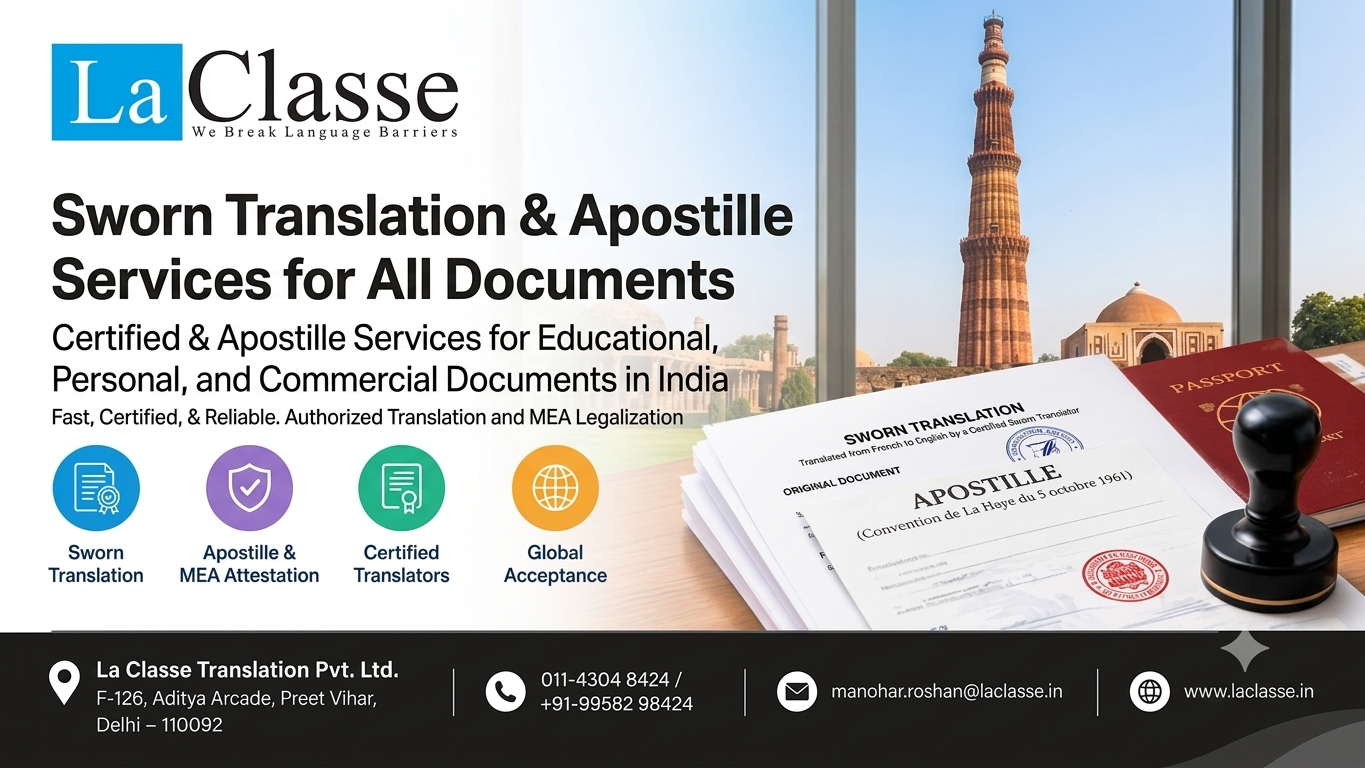
Professional Sworn Translation & Apostille Services in India help applicants prepare documents for international use by combining translation support with document authentication. This can be particularly useful for students applying for overseas education, professionals applying for work permits, families submitting civil documents, and individuals completing immigration procedures.
Understanding the difference between these services can help you determine what your documents actually require and avoid unnecessary processing.
What Is Sworn Translation?
A sworn translation is an official translation prepared by a translator who is authorised or recognised under the applicable system to provide translations for legal or administrative purposes.
Unlike an ordinary translation prepared simply for understanding, a sworn or certified translation may include a translator's certification, declaration, stamp, signature, or other details confirming the accuracy of the translation.
The exact requirements vary between countries and authorities. Some institutions may specifically request a sworn translation, while others may accept a certified translation from a qualified translator.
Before ordering a translation, it is important to check the requirements of the embassy, immigration authority, university, employer, or government office receiving the document.
What Is an Apostille?
An apostille is a form of authentication used for certain public documents intended for use in another country that participates in the Hague Apostille Convention.
The purpose of an apostille is generally to authenticate the origin of a public document so that it can be recognised by the authorities of another participating country.
An apostille does not translate the document and does not confirm that every statement contained in the document is factually correct. Instead, it provides authentication related to the document or the relevant signature/seal under the applicable process.
For applicants looking for Apostille Document Translation Services in India, it is therefore important to understand that translation and apostille are two different steps.
Sworn Translation and Apostille: Are They the Same?
No. Translation and apostille serve different purposes.
A translation converts the content of a document from one language into another. Apostille authentication, on the other hand, relates to the official recognition or authentication of the document for use abroad.
For example, an Indian applicant may have an educational document issued in English and need to submit it to a foreign authority. If the receiving authority requires the document to be authenticated and translated into another language, the applicant may need both services.
This is why Certified Translation and Apostille Services are often offered together as a convenient document-processing solution.
However, applicants should not assume that every document requires both. The exact requirement depends on the destination country, document type, purpose, and instructions of the receiving authority.
Professional Sworn Translation & Apostille Services in India
Applicants searching for Professional Sworn Translation & Apostille Services in India generally need support with two separate aspects of international document preparation: language conversion and authentication.
A professional service provider can help identify the documents that require translation, determine the appropriate language, review the paperwork for basic completeness, and coordinate the relevant authentication process where applicable.
This can reduce confusion when several documents are involved in a visa, immigration, education, or employment application.
For example, a student preparing documents for Germany may have academic certificates and transcripts that require translation, while another applicant preparing civil documents for a European immigration process may have different authentication requirements.
The correct procedure should always be determined according to the latest instructions of the relevant authority.
Germany Student Visa Document Translation and Apostille
Students preparing to study in Germany may need to submit academic and personal documents as part of their application.
Germany Student Visa Document Translation may involve certificates, transcripts, affidavits, or other supporting paperwork depending on the application and the institution or authority involved.
Applicants looking for German Certified Translation Services should first establish whether the receiving authority requires a certified, sworn, or another specific type of translation.
Similarly, Apostille for Germany Documents may apply to certain public documents, but not every document automatically needs an apostille. Requirements can differ according to the document and its intended use.
Before submitting paperwork, applicants should compare the requirements provided by the German embassy, consulate, university, or other relevant authority with the services being requested.
Italy Work Permit Document Translation and Legalisation
People applying for employment opportunities in Italy may encounter requirements involving translated and authenticated documents.
Italy Work Permit Document Translation can include employment-related paperwork, educational qualifications, civil documents, or other supporting records depending on the individual application.
Applicants searching for Italian Certified Translation should verify the exact format accepted by the Italian authority receiving the documents.
In some cases, the process may involve legalisation rather than an apostille. These terms should not be treated as interchangeable because the appropriate authentication route depends on the countries involved and the type of document.
A reliable Italy Document Legalisation Service can help applicants understand which authentication procedure is relevant before documents are submitted.
Spain Visa Document Translation and Apostille
Visa and immigration applications for Spain can involve documents issued in the applicant's home country.
Spain Visa Document Translation may be required when the original document is not in an accepted language or when the relevant Spanish authority specifically requests a particular form of translation.
Applicants searching for Spanish Certified Translation should confirm whether the authority requires a sworn translation, certified translation, or another accepted format.
Likewise, Spain Document Apostille Services can be relevant for eligible public documents where authentication is required. The need for apostille depends on the document and its intended use.
Preparing documents correctly before submission can help avoid delays caused by missing authentication or an unacceptable translation format.
France Visa Document Translation and Apostille
French visa, immigration, education, and administrative procedures can also involve translated documentation.
France Visa Document Translation may be required for certificates, civil records, educational documents, or other paperwork depending on the application.
People looking for French Certified Translation Services should pay attention to the exact requirements of the authority requesting the document. A translation that is acceptable for one organisation may not necessarily satisfy another.
For eligible documents, France Document Apostille Services may also be relevant. Applicants should confirm whether an apostille, legalisation, or another form of authentication is required before processing their documents.
Which Documents Commonly Require Translation or Authentication?
There is no universal list because requirements vary by country and purpose. However, applicants frequently seek assistance with:
Educational Documents
Degrees, diplomas, mark sheets, academic transcripts, and certificates may need translation or authentication for education, employment, or immigration purposes.
Civil Documents
Birth certificates, marriage certificates, divorce documents, and other civil records can be requested during immigration or family-related procedures.
Police Clearance Certificates
A police clearance certificate may be required for certain immigration, residence, or employment applications. Depending on the destination, additional authentication or translation may be necessary.
Employment Documents
Experience letters, employment certificates, contracts, and professional qualifications can sometimes require translation when submitted to an overseas employer or authority.
Legal Documents
Affidavits, powers of attorney, declarations, and other legal paperwork may have specific translation and authentication requirements.
Apostille vs Embassy Legalisation
Apostille and embassy legalisation are two different authentication procedures.
An apostille is generally used under the Hague Apostille Convention framework between participating countries. Embassy or consular legalisation may be used in situations where an apostille is not the applicable route.
Because the procedure depends on the destination country and document, applicants should not select a process based only on the name of the service.
If you are unsure whether you need Visa Document Legalisation Services, an apostille, or a specific type of certified translation, check the instructions issued by the receiving authority before processing the documents.
How Does a Translation and Apostille Service Work?
The process can vary, but a typical workflow may include the following stages.
First, the documents are reviewed to determine what type of service may be required. The documents are then translated into the requested language by an appropriate translator.
If authentication is required, the relevant document is processed through the applicable authentication or apostille procedure.
The completed documents are then checked before being returned to the applicant.
People searching for Document Translation and Apostille Services should provide clear scans or originals as requested and mention the exact purpose of the documents. This helps the service provider understand the intended use and applicable requirements.
How to Choose a Translation and Apostille Service in India
When selecting a provider, consider whether the service has experience with the destination country and the type of documents involved.
It is also useful to confirm:
- What type of translation is being provided
- Whether translator certification is included
- Whether apostille or legalisation is actually required
- Which authority will authenticate the document
- Expected processing stages
- Whether original documents are required
- Whether the service covers document delivery
A provider offering International Document Translation Services in India should be able to explain the process clearly rather than simply promising that every document will be accepted by every embassy or authority.
Why Professional Document Preparation Matters
International applications often involve strict documentation requirements. A missing certification, incorrect translation format, or inappropriate authentication route can result in additional processing or the need to submit documents again.
Professional Visa Document Translation Services can help applicants organise the language and authentication aspects of their paperwork. However, the final acceptance of a document always depends on the authority receiving it.
Applicants should therefore treat professional translation and apostille services as document-preparation support rather than a guarantee of visa approval, immigration approval, employment, or admission.
Frequently Asked Questions
Do all visa documents need an apostille?
No. The requirement depends on the country, document type, and purpose for which the document is being submitted.
Is an apostille the same as a translation?
No. Translation changes the language of a document, while an apostille is an authentication mechanism for eligible documents.
Can one service handle translation and apostille?
Some providers offer both services as a combined package. Applicants should confirm exactly what is included before placing an order.
How do I know whether I need sworn or certified translation?
Check the current instructions of the embassy, immigration authority, university, employer, or government office requesting the document. The terminology and requirements can vary.
Can educational certificates be translated and apostilled?
In many cases, educational documents can be processed for international use, but the exact authentication and translation requirements depend on the destination country and receiving authority.
Pros and Cons of Using Professional Translation and Apostille Services
Before choosing a professional provider, it is useful to understand both the advantages and possible limitations of outsourcing document translation and authentication. The right option can depend on the number of documents, destination country, deadline, and requirements of the receiving authority.
Pros of Professional Translation and Apostille Services
1. One Point of Coordination
A professional provider can make it easier to coordinate translation and authentication requirements, particularly when an application involves multiple documents.
2. Assistance With Different Languages
International applications may require documents in languages such as German, Italian, Spanish, or French. Professional language service providers can help applicants understand the translation requirements associated with different destinations.
3. Less Administrative Work
Applicants may have to manage several stages when preparing documents for overseas use. Professional assistance can reduce some of the administrative work involved in arranging translation and document authentication.
4. Better Understanding of Document Requirements
A professional provider can explain the difference between a standard translation, certified translation, sworn translation services, apostille, and legalisation. This can help applicants ask the right questions before processing their documents.
5. Convenient for Applicants Across India
Applicants do not necessarily have to be located in one particular city to seek professional language assistance. People preparing documents from Delhi, Mumbai, Bangalore, Hyderabad, Pune, Chennai, Kolkata, Ahmedabad, Jaipur, Lucknow, Chandigarh, and other parts of India may seek services based on their requirements.
Cons and Things to Consider
1. Additional Service Cost
Using a professional Apostille service generally costs more than preparing or translating documents independently. Applicants should compare the services included in the quoted price before making a decision.
2. Not Every Document Requires Apostille
An applicant may not need authentication for every document. The requirement should be confirmed with the authority receiving the paperwork rather than assuming that an apostille is necessary.
3. Requirements Can Change
Embassy, immigration, university, and government requirements can change. A professional provider can assist with document preparation, but applicants should verify the latest requirements with the relevant authority.
4. Processing May Involve Multiple Stages
Translation and authentication are separate processes. Depending on the documents and destination, completing both may take longer than translation alone.
5. Final Acceptance Is Not Guaranteed
A Translation or apostille service does not guarantee visa approval, immigration approval, university admission, employment, or acceptance of a document by a particular authority. The final decision always belongs to the organisation receiving the documents.
Why Choose La Classe for Translation and Language Support?
For applicants looking for professional language assistance in India, La Classe can be considered when preparing documents for international use.
La Classe focuses on language and translation-related services, making it relevant for students, professionals, businesses, and individuals who need multilingual documentation for international purposes.
Whether you are preparing documents for Germany, Italy, Spain, France, or another destination, it is useful to provide the service provider with complete information about the intended use of your documents. This may include the destination country, type of application, document category, and any instructions received from the relevant authority.
La Classe can be contacted to discuss the specific translation requirement and understand the available service options. Instead of assuming that every document requires the same process, applicants can first clarify whether they need a particular type of translation, certification, apostille, or legalisation.
For more information and enquiries, visit the official La Classe website.
What Makes Professional Support Useful?
The main benefit of working with a professional language service is having assistance throughout the document-preparation process. This can be particularly useful when an applicant has several documents or needs translations in different languages.
For example, a student applying to a foreign university may have academic certificates and transcripts, while a professional applying for an overseas work permit may need employment records and qualifications. A family completing an immigration process may instead need civil documents such as birth or marriage certificates.
By discussing the documents with La Classe before processing, applicants can explain their specific purpose and receive information about the translation service that may be appropriate for their paperwork.
It is still important to verify the final requirements with the relevant embassy, university, employer, immigration authority, or government department.
Get Professional Translation Assistance From La Classe
If you are preparing documents for an international application and need help understanding the translation requirement, La Classe can be an option to explore.
From applicants in major Indian cities such as Delhi and Mumbai to students and professionals in Bangalore, Pune, Hyderabad, Chennai, Kolkata, Ahmedabad, Jaipur, and Lucknow, professional language support can make multilingual document preparation more organised.
Visit the La Classe official website to learn more about its language and translation services and to make an enquiry regarding your documents.
Conclusion
Preparing documents for international use involves more than simply translating them into another language. Depending on your destination and purpose, you may need sworn translation, certified translation, apostille, or document legalisation.
Whether you are preparing paperwork for a German student visa, an Italian work permit, or Spanish or French immigration procedures, understanding the specific requirements before processing your documents can save time and prevent avoidable errors.
Professional Sworn Translation and Apostille Services in India can provide practical assistance with document translation and authentication, while the final requirements should always be confirmed with the relevant embassy, government authority, educational institution, employer, or immigration office.
Contact :
📞 +91-9958298424 / +91-9315762227
📧 manohar.roshan@laclasse.in
🏢 Delhi Office: F-126, Aditya Arcade, Preet Vihar, Delhi-110092.