
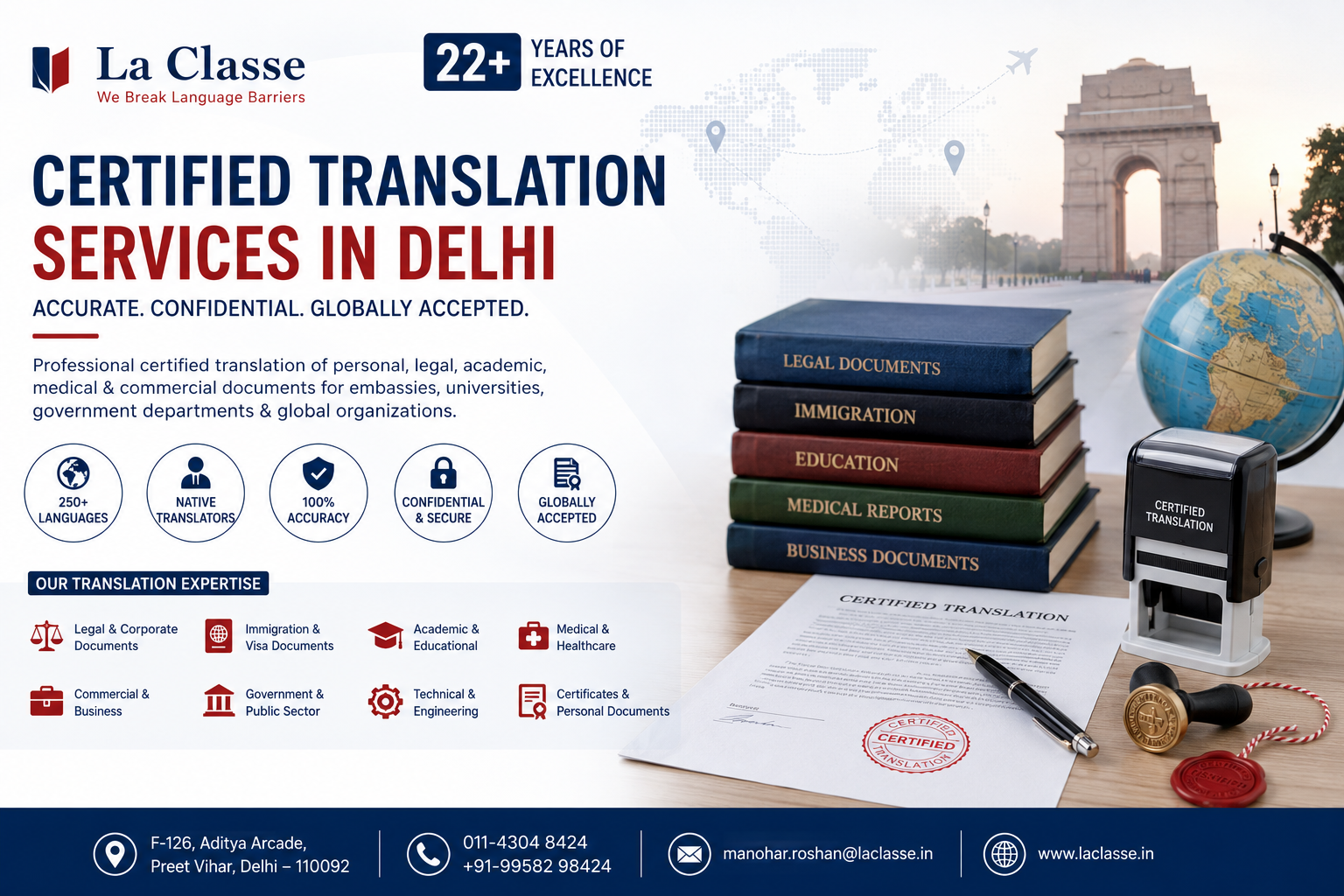
International education, overseas employment, immigration, business expansion, and cross-border legal procedures have made certified document translation an essential requirement rather than an optional service. Whether you are applying to a foreign university, submitting documents to an embassy, completing immigration formalities, or expanding your business internationally, the accuracy of your translated documents directly affects the success of your application.
Many applicants spend months preparing their paperwork but overlook one critical detail—the quality and authenticity of the translation. Even a minor error in names, dates, legal terminology, formatting, or official declarations can result in document rejection, unnecessary delays, or requests for resubmission. This is why government authorities, embassies, universities, and international organizations increasingly prefer translations completed by experienced professionals who understand both language and compliance requirements.
If you are searching for Certified Translation Services in Delhi, this guide explains everything you need to know—from the meaning of certified translation and the documents that require it to embassy expectations, quality standards, common mistakes, and how to choose the right translation company for official use.
With 22+ years of professional experience, La Classe Translation Pvt. Ltd. has helped thousands of students, professionals, corporate organizations, law firms, healthcare institutions, and individuals obtain professionally translated documents accepted for official international purposes. Our structured quality assurance process, experienced native linguists, and commitment to document accuracy have made us one of the trusted names for certified translation solutions in Delhi NCR.
Quick Answer
Certified Translation Services in Delhi involve professionally translating official documents while preserving their original meaning, formatting, and legal accuracy. A certified translation includes a declaration confirming that the translation is complete and accurate to the best of the translator's knowledge, making it suitable for submission to embassies, universities, immigration departments, courts, and various international authorities.
Unlike automated translation tools, certified human translation focuses on linguistic precision, document integrity, administrative compliance, and contextual understanding, ensuring your documents meet international acceptance standards.
Why Certified Translation Matters More Than Ever in 2026
Global mobility continues to grow rapidly. Every year, thousands of students from Delhi pursue higher education abroad, professionals relocate for international careers, families apply for dependent visas, businesses establish overseas partnerships, and organizations participate in cross-border commercial activities.
Almost every one of these processes requires official documents translated into another language.
These may include:
- Birth Certificates
- Marriage Certificates
- Degree Certificates
- Academic Transcripts
- Passport Copies
- Police Clearance Certificates
- Medical Reports
- Commercial Agreements
- Memorandum of Association (MOA)
- Articles of Association (AOA)
- Court Judgments
- Power of Attorney
- Financial Statements
- Income Proof
- Employment Certificates
For official submissions, authorities expect translated documents to be accurate, complete, professionally formatted, and free from interpretation errors.
This is where Certified Translation Services in Delhi become essential—not just for converting words from one language to another but for ensuring every document maintains its legal and administrative value throughout the international verification process.
What Is Certified Translation?
Certified translation is the process of translating an official document by a qualified translator or professional translation company, accompanied by a certification stating that the translated version accurately represents the original document.
A certified translation generally includes:
- Complete translation without omissions
- Accurate legal and technical terminology
- Correct names, dates, numbers, and references
- Preservation of document structure
- Translator or company certification
- Official declaration of accuracy
- Quality verification before delivery
The objective is not simply readability but official acceptance.
This distinction is important because international authorities often evaluate the translated document alongside the original. Any mismatch, inconsistency, or formatting issue may create unnecessary complications.
Certified Translation vs. Standard Translation
| Feature | Certified Translation | Standard Translation |
|---|---|---|
| Official Acceptance | Yes | Usually No |
| Certification Statement | Included | Not Included |
| Legal Accuracy | High Priority | General Purpose |
| Embassy Submission | Suitable | Often Rejected |
| University Applications | Accepted (where required) | May Not Qualify |
| Immigration Documentation | Commonly Required | Limited Use |
| Quality Verification | Multi-level Review | Depends on Provider |
| Formatting Preservation | Yes | Not Always |
This comparison highlights why official authorities generally recommend certified translations for administrative and legal purposes instead of ordinary language conversion.
Why Human Translation Is Still Better Than AI Translation
Artificial Intelligence has transformed the translation industry, making instant translations available in seconds. While AI tools are useful for understanding everyday conversations or basic content, they are not designed to replace professional human translators for official documentation.
Government authorities, embassies, universities, and legal institutions evaluate much more than vocabulary. They assess whether the translated document preserves the original legal meaning, formatting, context, terminology, seals, annotations, signatures, and administrative structure.
For example, a birth certificate contains names, registration details, issuing authority information, official remarks, and formatting conventions. Even if an AI tool translates the words correctly, it may fail to maintain the exact structure or correctly interpret abbreviations and administrative terminology used by the issuing authority.
Professional translators understand these nuances because they work within specific subject areas such as legal, academic, medical, financial, or immigration documentation.
This expertise significantly reduces the risk of translation-related issues during official verification.
Documents That Commonly Require Certified Translation
Different organizations have different documentation requirements. However, the following documents are among the most frequently translated for international use.
Personal Documents
Personal records often form the foundation of immigration, visa, and identity verification processes.
Examples include:
- Birth Certificate
- Marriage Certificate
- Divorce Certificate
- Death Certificate
- Passport
- Aadhaar Card
- PAN Card
- Driving Licence
- Police Clearance Certificate
These documents require careful handling because even a small spelling inconsistency can create complications during verification.
Academic Documents
Students planning to study abroad frequently require certified translations for university admissions and credential evaluations.
Common academic documents include:
- Degree Certificate
- Diploma
- Mark Sheets
- Academic Transcripts
- School Leaving Certificate
- Migration Certificate
- Recommendation Letters
- Internship Certificates
- Research Papers
- Academic Awards
Universities often compare translated records with originals during admission assessments, making translation accuracy extremely important.
Legal Documents
Legal paperwork demands specialized terminology and contextual precision.
Examples include:
- Court Orders
- Affidavits
- Agreements
- Contracts
- Power of Attorney
- Property Documents
- Company Registration Papers
- Legal Notices
- Arbitration Documents
Because legal terminology varies between jurisdictions, experienced legal translators play an important role in maintaining document reliability.
Immigration Documents
Immigration authorities require consistency across all submitted documents.
Common examples include:
- Visa Applications
- Employment Records
- Experience Letters
- Salary Certificates
- Bank Statements
- Financial Declarations
- Sponsorship Documents
- Family Records
Professional translation helps ensure that every document supports your application without unnecessary discrepancies.
Medical Documents
Healthcare documentation often contains technical language that requires specialized knowledge.
These may include:
- Medical Reports
- Diagnostic Results
- Prescription History
- Hospital Discharge Summaries
- Vaccination Records
- Clinical Reports
- Insurance Documents
Accurate translation is particularly important when these documents are reviewed by hospitals, insurance providers, or medical authorities in another country.
Where Are Certified Translations Used?
One of the biggest misconceptions is that certified translation is required only for visa applications. In reality, official translations are used across multiple industries and administrative processes.
Some common situations include:
- International university admissions
- Student visa processing
- Work permits
- Permanent residency applications
- Business expansion overseas
- Foreign company registration
- International tenders
- Embassy documentation
- Court proceedings
- Intellectual property filings
- Medical treatment abroad
- International insurance claims
- Cross-border financial transactions
As globalization continues to increase, certified translations have become an important part of international documentation workflows.
Why Delhi Has Become a Major Hub for Certified Translation Services
Delhi is home to numerous embassies, multinational companies, international educational consultants, legal institutions, and government offices. As a result, thousands of individuals and organizations require professionally translated documents every month.
Whether someone is applying for higher education in Europe, seeking employment in the Middle East, establishing a business in Asia, or completing documentation for North America, Delhi serves as a central location for international documentation services.
This growing demand has also increased the importance of choosing experienced professionals rather than relying on inexpensive automated solutions or uncertified translations.
Professional Certified Translation Services in Delhi combine language expertise, quality assurance, and compliance-focused processes to help applicants prepare documents that meet international expectations while reducing the chances of avoidable administrative delays.
this growing demand has also increased the importance of choosing experienced professionals rather than relying on inexpensive automated solutions or uncertified translations. Professional Certified Translation Services in Delhi combine language expertise, quality assurance, and compliance-focused processes to help applicants prepare documents that meet international expectations while reducing the chances of avoidable administrative delays.
However, preparing an official translation is only one part of the process. The next question most applicants have is whether every translated document is accepted automatically. The answer depends on the purpose of submission, the destination country, and the specific requirements of the authority reviewing your documents. Understanding these requirements before starting the translation process can save valuable time and prevent avoidable rework later.
When Is Certified Translation Required?
Not every document requires certified translation, but whenever an official authority needs to understand a document issued in another language, certified translation becomes essential. Embassies, immigration departments, universities, courts, multinational companies, and government agencies often require translated documents that accurately reflect the original content without altering its legal meaning.
For example, if your birth certificate has been issued in Hindi but a university in Germany requests documents in English or German, simply translating the text yourself or using an online translation tool is generally not considered sufficient. The institution may expect a professionally prepared certified translation that maintains the original structure, terminology, and official details.
Similarly, businesses entering international markets frequently require certified translations of contracts, financial reports, incorporation documents, compliance records, and shareholder agreements before they can complete cross-border transactions or regulatory registrations.
This is one of the reasons why Certified Translation Services in Delhi have become increasingly important for individuals as well as organizations that deal with international documentation on a regular basis.
Understanding Embassy and Government Expectations
One common misconception is that all embassies follow exactly the same documentation rules. In reality, each country may have its own translation and document acceptance policies. Some authorities accept certified translations issued by recognized professional translation companies, while others may require additional notarization, legalization, apostille, or country-specific verification.
Before beginning the translation process, applicants should always confirm:
- Which language the documents must be translated into
- Whether certified translation is sufficient
- Whether notarization is required
- Whether apostille or legalization is necessary
- Whether original formatting must be preserved
- Whether scanned copies are accepted
- Whether physical certified copies are mandatory
Ignoring even one of these requirements can delay visa processing, university admissions, employment verification, or business registrations.
This is why experienced translation professionals carefully review the purpose of submission before beginning any project instead of simply translating the text word for word.
Why Accuracy Is More Important Than Literal Translation
Official document translation is not about replacing one language with another. It is about preserving meaning, legal intent, and administrative accuracy.
Consider a legal affidavit or a court judgment. Certain legal expressions may not have a direct word-for-word equivalent in another language. Translating them literally can change the legal interpretation of the document, which may create problems during official review.
Experienced human translators analyze:
- Context
- Legal terminology
- Administrative language
- Country-specific document standards
- Subject-specific vocabulary
- Official formatting requirements
Only after understanding these factors do they prepare the translated version.
This contextual approach is one of the biggest differences between professional certified translation and automated machine-generated translations.
How Professional Certified Translation Is Actually Performed
Many people imagine that professional translation simply involves converting text into another language. In reality, every officially translated document goes through multiple quality checkpoints before final delivery.
Although internal workflows may vary from one company to another, a professional translation project generally includes the following stages.
1. Document Assessment
The first step is understanding the document itself.
Experts examine:
- Document type
- Source language
- Target language
- Number of pages
- Technical complexity
- Formatting requirements
- Submission purpose
This evaluation helps determine the most suitable translator for the project.
2. Subject-Matter Assignment
A medical report should ideally be translated by someone familiar with medical terminology, while legal agreements require translators with legal expertise.
Professional translation companies assign projects according to specialization rather than using a general translator for every document.
Common specialist categories include:
- Legal translators
- Academic translators
- Medical translators
- Financial translators
- Technical translators
- Commercial translators
This specialization improves both linguistic accuracy and subject relevance.
3. Native Language Translation
Once the document is assigned, the translator carefully converts every section while preserving the original meaning, formatting, dates, figures, abbreviations, seals, signatures, and references wherever applicable.
Instead of producing a literal translation, the objective is to create a document that reads naturally while remaining completely faithful to the source.
4. Independent Proofreading
Professional translation does not end after the first draft.
An independent reviewer checks:
- Grammar
- Spelling
- Terminology
- Consistency
- Formatting
- Missing content
- Numerical accuracy
- Proper nouns
- Official references
This second layer of review significantly reduces the possibility of errors.
5. Quality Assurance and Certification
Before delivery, the translation undergoes a final quality audit.
This stage verifies:
- Completeness
- Layout consistency
- Administrative compliance
- Linguistic accuracy
- Certification requirements
Only after passing these checks is the certified translation prepared for delivery.
Languages Commonly Requested in Delhi
Because Delhi serves as a major international business and education hub, translation requests cover a wide range of language combinations.
Some of the most frequently requested language pairs include:
- Hindi to English
- English to Hindi
- English to German
- German to English
- English to French
- French to English
- English to Spanish
- Spanish to English
- English to Arabic
- Arabic to English
- English to Japanese
- Japanese to English
- English to Chinese
- Chinese to English
- English to Russian
- Russian to English
- English to Italian
- English to Portuguese
Organizations working globally may also require translations in less commonly requested languages, making multilingual capability an important factor when selecting a translation provider.
Common Reasons Official Documents Get Rejected
One of the most frustrating situations for applicants is discovering that their translated documents have been rejected after submission. In many cases, the issue is not with the original document but with avoidable mistakes in the translation itself.
Some of the most common reasons include:
Incorrect Names
Even a minor variation in spelling compared with the passport or other official records can create inconsistencies.
Missing Information
Leaving out stamps, handwritten notes, footnotes, or official remarks can make the translation incomplete.
Incorrect Dates or Numbers
Errors in dates, registration numbers, financial figures, or certificate numbers may require the entire document to be translated again.
Poor Formatting
Many authorities expect translated documents to follow the structure of the original. A completely different layout may create confusion during verification.
Machine Translation
Automated translations often struggle with legal, administrative, and technical terminology, increasing the likelihood of rejection for official purposes.
Lack of Certification
Some institutions specifically request certified translations. Submitting an ordinary translation in such cases may not satisfy their documentation requirements.
The Value of Local Expertise in Delhi
While translation services are available across India and online, working with a company that understands local documentation practices can make the process smoother. Delhi handles a high volume of embassy submissions, immigration paperwork, academic applications, and business documentation, giving experienced translation providers practical insight into common documentation expectations.
With 22+ years of experience, La Classe Translation Pvt. Ltd. has supported individuals, professionals, businesses, and institutions with certified translations across 250+ languages. Every project is handled through a structured quality process that focuses on accuracy, confidentiality, formatting consistency, and administrative compliance—helping clients prepare documents for international use with greater confidence.
As the number of global applications continues to grow, choosing the right translation partner is no longer just about language expertise. It is equally about reliability, compliance, subject knowledge, and the ability to deliver documents that meet official standards the first time. Understanding what to look for in a professional translation company—and the factors that directly influence document acceptance—is the next step before submitting any important paperwork.
Understanding what to look for in a professional translation company—and the factors that directly influence document acceptance—is the next step before submitting any important paperwork.
Making the right choice at this stage can save you from unnecessary delays, additional expenses, and repeated document submissions. While there are many translation providers available today, not every company follows the same quality standards or understands the documentation requirements of international authorities. A certified translation is often reviewed by people who have never seen your original language, so the translated version becomes the primary document on which important decisions are made. That is why choosing a trusted translation partner should be based on expertise, transparency, and proven processes rather than price alone.
How to Choose the Right Certified Translation Company in Delhi
Searching online for Certified Translation Services in Delhi will show dozens of agencies, freelancers, and online platforms. However, the real difference lies in the quality of work, compliance standards, and long-term reliability. Before handing over important personal or business documents, it is worth evaluating a few essential factors that directly impact the acceptance of your translations.
1. Verify Industry Experience
Experience is one of the strongest indicators of translation quality. Companies that have worked on thousands of official documents over many years understand the expectations of embassies, universities, government departments, multinational organizations, and legal authorities.
An experienced translation provider is more likely to identify potential issues before the translation begins, helping clients avoid unnecessary corrections later in the process.
With 22+ years of experience, La Classe Translation Pvt. Ltd. has supported students, professionals, law firms, healthcare institutions, corporate organizations, exporters, and individuals with multilingual document translation across a wide range of official use cases.
2. Ensure Human Native Translators Handle the Project
Language is more than vocabulary. Every language has its own grammar, cultural nuances, administrative terminology, and legal expressions. These cannot always be interpreted correctly by software.
Professional translation companies assign projects to qualified human translators who understand both the source and target languages at a native or near-native level. This approach helps preserve meaning, tone, and official terminology while reducing the possibility of contextual errors.
For legal agreements, immigration files, medical records, or academic certificates, human expertise continues to be the preferred choice because precision is more important than speed.
3. Check Whether They Handle Different Document Categories
Every document requires a different level of subject knowledge. Translating a university transcript is very different from translating a court judgment or a pharmaceutical report.
A professional translation company should be capable of handling multiple categories, including:
Academic Documents
- Degree Certificates
- Diplomas
- Mark Sheets
- Academic Transcripts
- School Certificates
- Letters of Recommendation
Immigration Documents
- Passport Copies
- Birth Certificates
- Marriage Certificates
- Police Clearance Certificates
- Employment Records
- Financial Statements
Legal Documents
- Affidavits
- Court Orders
- Agreements
- Power of Attorney
- Property Papers
- Company Registration Documents
Commercial Documents
- Memorandum of Association (MOA)
- Articles of Association (AOA)
- Audit Reports
- Business Contracts
- Import–Export Documentation
- Corporate Presentations
Medical Documents
- Medical Reports
- Laboratory Results
- Clinical Summaries
- Insurance Records
- Prescription History
A translation provider with expertise across these categories can better match the document with the right subject specialist.
Why Document Formatting Is Just As Important As Translation
One area that many applicants underestimate is document formatting. International authorities often compare the translated document with the original version line by line. If the translated copy is poorly structured or omits important visual elements, it may slow down the verification process.
Professional translators therefore pay attention not only to the text but also to the overall layout.
This may include:
- Section headings
- Tables
- Stamps
- Official seals
- Signatures
- Footnotes
- Marginal notes
- Registration numbers
- Page numbering
- Institutional references
Maintaining structural consistency helps reviewers quickly compare both versions and improves overall readability.
Why Confidentiality Matters During Translation
Official documents frequently contain highly sensitive information, including passport numbers, financial records, legal matters, educational history, medical reports, employment details, and personal identification data.
Sharing such information with an unreliable provider can expose individuals and businesses to unnecessary risks.
When choosing Certified Translation Services in Delhi, it is important to ensure that the company follows secure document handling practices, such as:
- Controlled document access
- Secure digital storage
- Confidential processing
- Restricted project access
- Safe online document submission
- Responsible document disposal after project completion
Professional translation is not only about linguistic accuracy—it also involves protecting client information throughout the entire workflow.
Industries That Depend on Certified Translation Services
As businesses and institutions become increasingly global, certified translation supports a wide variety of sectors beyond immigration and education.
Some of the major industries include:
Higher Education
Universities require translated academic records for admissions, scholarship applications, exchange programs, and credential evaluations.
Healthcare
Hospitals and healthcare organizations use certified translations for patient records, treatment summaries, insurance documentation, and medical research.
Legal Services
Law firms frequently require translated contracts, litigation documents, arbitration records, affidavits, and judicial decisions.
International Business
Companies expanding into overseas markets need multilingual business documentation for compliance, taxation, licensing, tenders, and cross-border partnerships.
Government and Public Administration
Government departments often process multilingual public notices, policy documents, regulatory communications, and official correspondence.
The increasing reliance on international documentation means certified translation now plays an essential role across almost every professional sector.
The Growing Demand for Certified Translation in Delhi NCR
Delhi NCR has emerged as one of India's busiest centers for international documentation. Every day, students prepare university applications, professionals submit employment records, entrepreneurs establish overseas businesses, and families complete immigration formalities.
As a result, the demand for Certified Translation Services in Delhi continues to increase across areas such as:
- Preet Vihar
- Laxmi Nagar
- Connaught Place
- South Delhi
- Dwarka
- Rohini
- Karol Bagh
- Saket
- Janakpuri
- Mayur Vihar
- Noida
- Gurugram
- Ghaziabad
- Faridabad
This regional demand has encouraged translation providers to adopt digital workflows, allowing clients to submit documents online while still receiving professionally certified translations suitable for official purposes.
Common Myths About Certified Translation
Despite its growing importance, several misconceptions still surround certified translation. Understanding the facts can help applicants make better decisions.
Myth 1: Google Translate Is Enough
Google Translate can be useful for understanding basic text, but it is not intended for official legal, academic, or administrative documentation. It cannot provide certification or guarantee contextual accuracy.
Myth 2: Every Translator Can Provide Certified Translation
Fluency in two languages alone does not automatically qualify someone to prepare certified translations for official use. Professional document translation requires subject expertise, quality control, and compliance with administrative requirements.
Myth 3: All Countries Have the Same Requirements
Translation policies differ between countries and institutions. Some authorities accept certified translations, while others may require notarization, legalization, apostille, or additional verification.
Myth 4: Certified Translation Takes Several Weeks
Completion time depends on document type, language pair, complexity, and volume. Many standard documents can be processed much faster through an organized workflow without compromising quality.
Practical Tips Before Submitting Documents for Translation
To make the translation process smoother, applicants should prepare their documents carefully before sending them for review.
A few simple practices can help avoid delays:
- Ensure scanned copies are clear and readable.
- Do not crop stamps, seals, or signatures.
- Submit all pages, even if one appears blank.
- Verify the spelling of names against your passport.
- Inform the translation company about the destination country.
- Mention whether the document will be used for a university, embassy, immigration office, court, or business purpose.
- Clarify if notarization, apostille, or legalization is also required.
Providing complete information at the beginning allows translators to prepare documents that better align with the intended use.
Why Professional Translation Is an Investment, Not Just a Service
When official documents are involved, the cost of correcting mistakes is often much higher than the cost of getting the translation right the first time. A rejected visa application, delayed university admission, postponed business registration, or additional courier and processing charges can quickly outweigh any savings made by choosing the cheapest translation option.
For this reason, experienced applicants often prioritize quality, subject expertise, and reliability over short-term cost considerations. A professionally prepared certified translation helps reduce uncertainty and supports smoother communication with international authorities.
As international documentation continues to evolve, applicants also need to understand how certified translation connects with other compliance processes such as notarization, attestation, and apostille. Knowing when each of these services is required—and how they work together—can make the entire documentation journey far more efficient while ensuring your paperwork is ready for acceptance across different countries.
Understanding this relationship is especially important because certified translation is often just one step in a broader documentation process. Depending on your destination country and the purpose of your application, your translated documents may also need notarization, attestation, or apostille before they are considered valid by the receiving authority. Planning these steps in the correct order helps avoid unnecessary delays and ensures your documents are prepared according to international requirements.
Certified Translation, Notarization, Attestation, and Apostille – What's the Difference?
Many applicants use these terms interchangeably, but each serves a different purpose.
| Service | Purpose | Common Use |
|---|---|---|
| Certified Translation | Confirms that the translated document accurately represents the original. | Embassies, universities, immigration authorities, employers |
| Notarization | Verifies the identity and signature associated with a document or declaration. | Legal and administrative documentation |
| Attestation | Confirms the authenticity of a document through authorized departments. | Employment, education, and international verification |
| Apostille | Authenticates public documents for use in countries that are members of the Hague Apostille Convention. | International legal, educational, and commercial purposes |
Knowing which of these services is required depends entirely on the destination country and the organization requesting your documents. Consulting an experienced translation company before starting the process can help ensure that the correct sequence is followed.
Frequently Asked Questions
Is certified translation accepted by embassies?
Many embassies and foreign authorities accept professionally prepared certified translations when they meet the specific requirements of the receiving institution. Since documentation policies vary by country, applicants should always verify the latest requirements before submission.
Can I use Google Translate for visa or immigration documents?
No. Machine translation tools are useful for understanding general text but are not designed for official legal, academic, or immigration documentation. They cannot provide certification, contextual accuracy, or the quality assurance expected by official authorities.
How long does certified translation usually take?
The turnaround time depends on factors such as document type, number of pages, language pair, and complexity. Standard personal documents are often completed much faster than large legal or technical projects. Discussing timelines in advance helps avoid last-minute delays.
Which documents are most commonly translated?
The most frequently requested documents include:
- Birth Certificates
- Marriage Certificates
- Degree Certificates
- Academic Transcripts
- Passports
- Visa Documents
- Police Clearance Certificates
- Medical Reports
- Court Documents
- Commercial Agreements
- Power of Attorney
- Financial Statements
Can certified translations be submitted online?
Many organizations now accept digitally certified documents during the initial application stage. However, some authorities may later request physical copies or additional verification. It is always advisable to review the submission guidelines of the receiving institution.
Why choose a professional translation company instead of a freelancer?
Professional translation companies typically follow structured quality-control processes, assign projects to subject-matter experts, perform independent proofreading, and provide certification backed by established operational procedures. This level of consistency is particularly valuable for documents intended for official use.
Key Takeaways
Before submitting any document internationally, keep these important points in mind:
- Choose certified human translation for official documentation.
- Ensure names, dates, and document numbers match the originals exactly.
- Confirm the destination country's translation requirements in advance.
- Preserve document formatting and administrative details.
- Avoid relying solely on machine-generated translations.
- Work with experienced professionals familiar with legal and international documentation.
- Protect confidential information by selecting a trusted translation provider.
Following these practices can significantly reduce the likelihood of delays, requests for corrections, or document rejection.
Why Professionals Across Delhi Trust La Classe Translation Pvt. Ltd.
When official documentation is involved, accuracy, reliability, and compliance matter far more than speed alone. Over the years, La Classe Translation Pvt. Ltd. has built its reputation by delivering certified translation solutions that prioritize linguistic precision, document integrity, and international acceptance standards.
With 22+ years of experience, the company has assisted 10,000+ clients worldwide across 250+ languages, supporting students, professionals, corporate organizations, law firms, healthcare institutions, exporters, and individuals with multilingual documentation for global use.
Every project is managed through a structured workflow that includes:
- Native language experts
- Subject-specific translators
- Multi-level proofreading
- Formatting verification
- Administrative quality checks
- Confidential document handling
- Secure digital submission
- Dedicated customer assistance
Whether the requirement involves academic records, immigration paperwork, legal agreements, medical reports, or commercial documentation, the objective remains the same—to deliver translations that are accurate, professionally prepared, and aligned with international documentation standards.
Get Expert Certified Translation Services in Delhi
If you are preparing documents for higher education, immigration, overseas employment, legal matters, business expansion, or international government submissions, working with an experienced translation team can make the process significantly smoother.
La Classe Translation Pvt. Ltd. offers certified document translation services designed to support individuals and organizations with accurate multilingual documentation while maintaining strict confidentiality, quality assurance, and compliance with official requirements.
Contact Information
📍 Office Address
F-126, Aditya Arcade, Preet Vihar, Delhi – 110092
📞 Phone
011-4304 8424 | +91-99582 98424
📧 Email
manohar.roshan@laclasse.in
🌐 Website
https://www.laclasse.in
Whether you prefer to visit the office, speak with a translation expert, or submit your documents online, the team is available to guide you through the entire process—from language selection and document assessment to certified translation and final delivery.
Final Thoughts
As international education, global employment, immigration, and cross-border business continue to grow, the importance of professionally prepared document translation has never been greater. Certified translation is no longer just about converting one language into another—it is about preserving meaning, maintaining legal accuracy, protecting document integrity, and ensuring that your paperwork is understood and accepted by authorities around the world.
Choosing the right translation partner means choosing experience, subject expertise, quality assurance, and a commitment to international standards. With 22+ years of proven experience, advanced multilingual capabilities, and a client-focused approach, La Classe Translation Pvt. Ltd. continues to support individuals and organizations seeking dependable Certified Translation Services in Delhi for official, academic, legal, medical, immigration, and commercial documentation.
Whether your documents are destined for an embassy, a university, a government department, or an international business partner, investing in accurate human translation today can help you avoid complications tomorrow—allowing your global journey to move forward with confidence.