
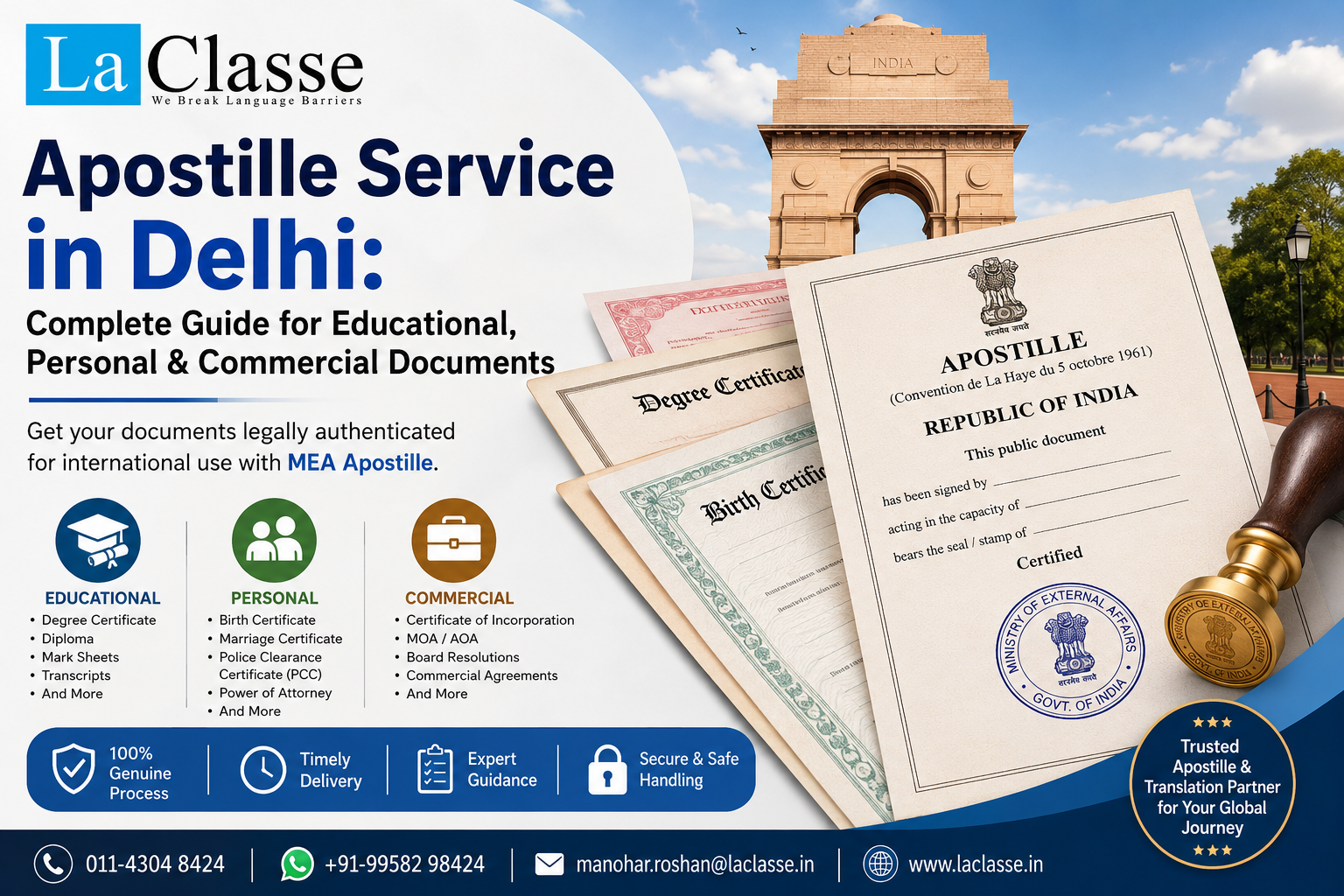
If you're planning to study, work, get married, start a business, or immigrate abroad, your Indian documents may need to be legally recognized in another country. For countries that are members of the Hague Convention, this is done through an Apostille Service in Delhi, where the Ministry of External Affairs (MEA) verifies the authenticity of your documents before they can be accepted internationally.
Whether you need to apostille a degree certificate, birth certificate, marriage certificate, police clearance certificate, or company documents, understanding the correct process can save you from unnecessary delays and document rejection.
Key Highlights
✔ Complete guide to the Apostille Service in Delhi
✔ Difference between Apostille and Embassy Attestation
✔ Educational, Personal & Commercial document requirements
✔ SDM vs HRD verification explained
✔ Common mistakes that lead to rejection
✔ Country-wise legalization requirements
✔ Certified translation requirements
✔ Expert guidance based on 22+ years of experience
Planning to Use Your Documents Abroad? Here's What You Need to Know
Every year, thousands of students, professionals, business owners, and families from Delhi require document legalization before moving overseas. Whether you're applying for higher education in Germany, accepting a job offer in Europe, expanding your business internationally, or submitting documents for family immigration, foreign authorities need proof that your Indian documents are genuine.
Simply having an original certificate isn't enough.
Most foreign universities, employers, immigration departments, and government authorities require documents to be authenticated before they are legally accepted.
This is where a professional Apostille Service in Delhi becomes essential.
Because New Delhi is home to the Ministry of External Affairs (MEA), Government of India, and many foreign embassies and diplomatic missions, it serves as one of the country's most important centers for document legalization and international document authentication.
Why Many Applications Get Delayed
One of the biggest misconceptions is that apostille is simply a stamp placed on a document.
In reality, the process involves multiple verification stages depending on the type of document you're submitting.
A small mistake—such as choosing the wrong verification route, submitting damaged documents, using an uncertified translation, or missing a mandatory pre-authentication step—can result in delays or rejection by overseas authorities. The original guide also emphasizes that mismatched signatures, incorrect pre-authentication, or translation issues can cause processing problems.
For this reason, understanding the complete process before submitting your documents is extremely important.
Expert Insight
With 22+ years of experience, La Classe Translation Pvt. Ltd. has assisted individuals, students, professionals, and businesses with document legalization, certified translation, and international documentation requirements. This guide is designed to simplify the complete process so applicants understand each stage before submitting their documents.
What is an Apostille?
An Apostille is an official authentication issued by the Ministry of External Affairs (MEA), Government of India, confirming that the signature, seal, or stamp on a public document is genuine.
It is primarily required when Indian documents are submitted in countries that are members of the Hague Convention.
It's important to understand that an Apostille does not certify the contents of your document. Instead, it certifies the authenticity of the issuing authority's signature or seal, allowing the document to be accepted in participating foreign countries. This distinction is also explained in the source guide.
Which Documents Usually Need an Apostille?
The requirement depends on the purpose of your international application. Common examples include:
Educational Documents
- Degree Certificates
- Diplomas
- Mark Sheets
- Academic Transcripts
Personal Documents
- Birth Certificates
- Marriage Certificates
- Divorce Decrees
- Police Clearance Certificates (PCC)
- Power of Attorney
Commercial Documents
- Certificate of Incorporation
- Memorandum of Association (MOA)
- Articles of Association (AOA)
- Export Documents
- Commercial Agreements
These categories match the document classifications described in the original guide.
Understanding the Hague Convention
One of the most important concepts to understand before starting the legalization process is the Hague Apostille Convention.
Before this international agreement existed, legalizing a document for another country often required multiple levels of verification, including local authorities, state departments, the national foreign ministry, and finally the destination country's embassy.
The Hague Convention simplified this process by introducing the Apostille system, allowing participating countries to recognize authenticated public documents through a standardized Apostille issued by the competent authority. The source guide explains that India became a member of this convention on 14 July 2005 and that the MEA issues Apostilles recognized by Hague member countries.
Apostille vs Embassy Attestation
Understanding the difference helps applicants choose the correct legalization route.
| Apostille | Embassy Attestation |
|---|---|
| Used for Hague Convention member countries | Used for countries outside the Hague Convention |
| Final authentication is through the MEA Apostille process | Requires additional legalization through the destination country's embassy after MEA processing |
| Commonly used for many European countries and other Hague members | Common for destinations such as the UAE and other non-Hague jurisdictions, as described in the guide. |
Understanding Which Documents Need an Apostille & How the Complete MEA Process Works
Now that you know what an Apostille is, why it is required, and how the Hague Convention simplified international document authentication, the next step is understanding which documents require apostille, which government authorities are involved, and how the complete verification process works before your documents are accepted overseas.
Many applicants assume that every document follows the same procedure. In reality, the MEA Apostille process varies depending on the type of document and the destination country. Choosing the wrong verification route can lead to unnecessary delays, additional expenses, or even rejection of your application.
Whether you're applying for higher education, an overseas job, family immigration, business expansion, or a long-term visa, selecting the correct Apostille Service in Delhi ensures your documents are processed smoothly and accepted by foreign authorities.
Which Documents Require an Apostille?
The Ministry of External Affairs (MEA) broadly categorizes documents into three major groups. Each category follows a different pre-authentication process before the final MEA Apostille can be issued.
1. Educational Documents
Educational documents are required when applying for:
- International universities
- Student visas
- Work permits
- Professional licensing
- Skill migration programs
Common educational documents include:
- Degree Certificate Apostille
- University Degree Certificates
- Diploma Certificates
- Academic Transcripts
- Mark Sheets
- School Leaving Certificates
- Migration Certificates
- Nursing & Medical Registration Certificates
- Professional Qualification Certificates
Students planning to study in countries like Germany, France, Italy, Spain, Australia, the Netherlands, or other Hague Convention member countries generally require Educational Certificate Apostille before submitting their academic documents.
Expert Tip: Before applying for an apostille, always verify whether your destination university requires the State HRD route or accepts the faster SDM verification route.
2. Personal Documents
Personal documents are among the most frequently apostilled records because they are required for immigration, marriage registration abroad, dependent visas, family sponsorship, and overseas employment.
Some commonly processed personal documents include:
- Birth Certificate Apostille
- Marriage Certificate Apostille
- Divorce Decree
- Police Clearance Certificate (PCC)
- Single Status Certificate
- Affidavits
- Adoption Documents
- Medical Certificates
- Power of Attorney (POA)
- Death Certificate
If you're applying for a spouse visa, permanent residency, or family reunification, a trusted Document Apostille Service in Delhi can help ensure these documents meet international legal requirements.
3. Commercial Documents
Businesses expanding internationally often require Commercial Document Apostille to establish legal recognition in foreign jurisdictions.
Examples include:
- Certificate of Incorporation
- Memorandum of Association (MOA)
- Articles of Association (AOA)
- Board Resolutions
- Commercial Power of Attorney
- Export Invoices
- Certificates of Origin
- Financial Statements
- Trademark Documents
- Business Agreements
Companies involved in international trade, foreign investments, or overseas partnerships commonly rely on Commercial Apostille Services in Delhi to complete this process efficiently.
Understanding the Complete Apostille Process in Delhi
One of the biggest misconceptions is that applicants can directly visit the Ministry of External Affairs and obtain an Apostille.
In reality, the MEA Apostille process follows a structured verification system. Every document must pass through specific verification stages before the Ministry of External Affairs issues the final Apostille sticker.
A simplified workflow looks like this:
Step 1 – Document Verification
The process begins with a detailed inspection of the original document.
During this stage, experts check:
- Original signatures
- Government seals
- Physical condition
- Lamination
- Name consistency
- Passport matching
- Missing pages or alterations
Even a small discrepancy can delay the Document Legalization Process.
Step 2 – Notary Attestation
After verification, eligible documents are authenticated by an authorized Notary Public.
This confirms that the document is genuine and ready for the next stage of government verification.
Although not every document follows an identical route, notary authentication is an important step in many apostille cases.
Step 3 – Pre-Authentication
This is one of the most important stages.
Depending on your document type, one of the following authorities performs the verification:
Personal Documents
- Home Department
- SDM (Sub-Divisional Magistrate)
Educational Documents
- State HRD
- Education Department
- SDM (where applicable)
Commercial Documents
- Chamber of Commerce
Selecting the correct authority is essential because using the wrong route can increase processing time.
Step 4 – MEA Apostille
After successful verification, the documents are submitted to the Ministry of External Affairs (MEA).
The Ministry verifies the signatures and seals of the previous authorities before issuing the official Apostille.
The Apostille contains:
- Unique Registration Number
- Government Authentication
- Official Apostille Sticker
- Verification Details
This confirms that the document has been authenticated for use in Hague Convention member countries.
Why Professional Verification Matters
Many applicants unknowingly delay their visa or university application by submitting incomplete or incorrectly verified documents.
Some common reasons include:
- Incorrect verification route
- Mismatched names
- Damaged certificates
- Missing supporting documents
- Improper notarization
- Incorrect document sequence
Choosing an experienced Apostille Service in Delhi helps reduce these risks and ensures your documents move through the verification process more efficiently.
Quick Checklist Before Applying for an Apostille
Before submitting your documents, make sure you have:
✔ Original document
✔ Valid passport copy
✔ Supporting documents (if applicable)
✔ Correct spellings across all documents
✔ Required pre-authentication completed
✔ Verified destination country requirements
Completing these checks beforehand can save valuable time during the legalization process.
Should You Choose the SDM Route or the State HRD Route?
Now that you understand which documents require an Apostille, how the complete MEA verification process works, and why selecting the correct authentication route is essential, the next question is one that almost every applicant asks:
Should you choose the SDM Route or the State HRD Route?
The answer depends on your document type, the country where you are submitting it, and the specific requirements of the receiving university, employer, or government authority. Choosing the correct route can save significant time, while selecting the wrong one may delay your visa, admission, or business application.
SDM Route vs State HRD Route – Which One is Better?
Both verification routes are accepted by the Ministry of External Affairs (MEA) before issuing the final Apostille. However, they serve different purposes and are not always interchangeable.
| Feature | SDM Route | State HRD Route |
|---|---|---|
| Best For | Personal documents & many educational documents | Educational documents where specifically required |
| Processing Speed | Generally faster | Usually longer due to university verification |
| Verification Authority | Sub-Divisional Magistrate (SDM) | State Human Resource Development Department |
| Suitable For | Many Hague Convention countries | Universities or authorities requiring state-level verification |
For applicants looking for a faster Apostille Service in Delhi, the SDM Route is often preferred because it reduces dependency on state education boards. However, some universities and foreign institutions may specifically request State HRD verification before the MEA Apostille is issued.
Expert Insight: Before starting the process, always confirm the document legalization requirements with your destination country or institution. A professional Document Authentication Service in Delhi can help identify the correct route based on your case.
When is the SDM Route Recommended?
The SDM (Sub-Divisional Magistrate) Route is commonly selected when applicants need a quicker verification process for eligible documents.
It is often suitable for:
- Birth Certificate Apostille
- Marriage Certificate Apostille
- Police Clearance Certificates (PCC)
- Affidavits
- Power of Attorney
- Many educational documents accepted through the SDM route
Because SDM verification is generally streamlined, many applicants prefer it for study, employment, or immigration timelines where faster processing is important. The source guide notes that this route is widely accepted for many Hague Convention destinations and can often be completed more quickly than the traditional HRD route.
When is the State HRD Route Required?
The State HRD Route is primarily associated with Educational Certificate Apostille.
Under this process, the relevant state education authority verifies academic records with the issuing university or board before they proceed to the Ministry of External Affairs.
This route may be required for:
- Degree Certificates
- University Diplomas
- Academic Transcripts
- Professional Qualification Certificates
- Certain higher education applications
Since this verification may involve communication with the issuing institution, the processing time is usually longer than the SDM route. The original guide explains that HRD processing can vary depending on the responsiveness of the university or state department.
Country-Specific Apostille Requirements
Every country has its own documentation policies. While many countries accept an MEA Apostille, additional requirements—such as certified translation or embassy legalization—may still apply.
Understanding these differences before submitting your documents helps avoid unnecessary delays.
Germany
Germany generally accepts MEA Apostille on eligible educational and personal documents. However, universities and authorities frequently require Certified German Translation along with the authenticated documents.
If you are planning to study or work in Germany, combining Apostille Service in Delhi with professional Certified Translation Services can simplify the documentation process.
United States
The United States accepts MEA Apostille for many personal, educational, and commercial documents intended for use within Hague Convention procedures.
For documents issued in regional Indian languages, certified English translation may still be required before submission.
Italy
Italy follows a stricter documentation process for certain educational records.
Depending on the institution, applicants may require:
- Educational document verification
- MEA Apostille
- Certified Italian translation
- Additional embassy-related documentation where applicable
Because requirements can vary, it is advisable to verify the latest instructions from the receiving institution or authority. The source guide highlights Italy's stricter verification and translation expectations.
Spain
Applicants submitting documents in Spain generally require an MEA Apostille along with Certified Spanish Translation, especially for educational and personal records.
Proper translation plays an important role because the Apostille authenticates the document—it does not translate its contents.
United Arab Emirates (UAE)
The UAE follows a different legalization route because it is not covered by the Hague Apostille system.
Instead of a Hague Apostille, documents typically require:
- Pre-authentication
- MEA Attestation
- Embassy legalization through the UAE Embassy
This distinction is clearly explained in the original guide and is important for applicants heading to non-Hague countries.
Why Certified Translation is Equally Important
One of the most common misunderstandings among applicants is believing that an Apostille automatically makes a document acceptable in every country.
In reality, the Apostille only verifies the authenticity of the signature or seal. It does not translate the document into another language.
If your destination country requires documentation in its official language, you may also need:
- Certified Translation Services
- Legal Translation Services
- Sworn or officially accepted translations, depending on local rules
For countries such as Germany, Spain, Italy, or France, translation requirements may form an essential part of the documentation package, as outlined in the source guide.
Common Mistakes That Delay the Apostille Process
Even genuine documents can face delays if the preparation stage is overlooked.
Some common issues include:
- Laminated documents that cannot be processed without proper handling.
- Name mismatches between certificates and passport records.
- Incorrect or expired pre-authentication.
- Submitting documents through an incorrect verification route.
- Using unofficial or uncertified translations where certified versions are required.
The original guide identifies these as frequent causes of rejection or delay and emphasizes careful document preparation before submission.
Pro Tips for a Smoother Apostille Process
Before starting your application:
✔ Verify the destination country's documentation requirements.
✔ Check whether your educational institution specifically requires the HRD route.
✔ Ensure names and dates are consistent across all supporting documents.
✔ Confirm whether certified translation is required.
✔ Work with an experienced Apostille Consultant in Delhi if your case involves multiple document types or country-specific requirements.
Why Choosing the Right Apostille Service Provider Matters
Now that you understand the difference between the SDM and HRD routes, country-specific legalization requirements, and the role of certified translation, the final step is selecting a reliable service provider who can guide you through the process accurately and efficiently.
International document legalization is more than collecting stamps from different departments. Every document follows a specific verification route, and even a small mistake—such as incorrect pre-authentication, missing supporting documents, or an uncertified translation—can delay your application.
Whether you need an Apostille Service in Delhi for higher education, overseas employment, immigration, or international business, working with an experienced team helps reduce delays and ensures your documents are prepared according to the requirements of the receiving country.
Why Choose La Classe Translation Pvt. Ltd.?
For over 22+ years, La Classe Translation Pvt. Ltd. has been assisting students, professionals, families, and businesses with document authentication, certified translation, and legalization services.
Our focus is not only on processing documents but also on helping applicants understand the correct procedure before submission.
Our Key Advantages
✔ 22+ Years of Industry Experience
With decades of experience in Document Authentication Services, Certified Translation Services, and MEA Apostille support, our team understands the documentation requirements of different countries and institutions.
✔ End-to-End Documentation Assistance
Applicants often need multiple services together, such as:
- Certificate Apostille
- MEA Attestation
- Certified Translation
- Legal Translation
- Educational Document Verification
- Commercial Document Authentication
Managing these services through one experienced team helps simplify the overall process.
✔ Convenient Delhi Location
Located in Preet Vihar, Delhi, our office offers convenient access for applicants across Delhi NCR.
We regularly assist clients from:
- Preet Vihar
- Laxmi Nagar
- Mayur Vihar
- Connaught Place
- Saket
- Dwarka
- Rohini
- Janakpuri
- Rajouri Garden
- Noida
- Greater Noida
- Gurugram
- Faridabad
- Ghaziabad
This wide service coverage makes it easier for individuals and businesses looking for a trusted Apostille Service in Delhi.
✔ Secure Document Handling
Original documents are valuable and often irreplaceable.
For that reason, careful handling, organized processing, and secure documentation practices are essential throughout the legalization journey. The source guide highlights secure handling and chain-of-custody practices as an important advantage.
Frequently Asked Questions (FAQs)
1. How long does the Apostille process take in Delhi?
Processing time depends on the document category and verification route. As described in the guide, the SDM route is generally faster, while State HRD verification for educational documents may take longer because it involves verification with the issuing institution.
2. Is an Apostille required for every country?
No.
Countries that are members of the Hague Convention generally use the Apostille system. Non-Hague countries usually require MEA Attestation followed by embassy legalization.
3. Can laminated documents be apostilled?
Laminated documents may require special handling because the Apostille sticker must be applied correctly. The original guide notes that lamination can prevent normal processing and should be addressed before submission.
4. Is Certified Translation required after an Apostille?
An Apostille authenticates the document—it does not translate it.
If your destination country requires documentation in its official language, Certified Translation Services or legally accepted translations may also be necessary.
5. Can I submit documents directly to the Ministry of External Affairs?
The guide explains that submissions are generally processed through authorized channels rather than direct individual walk-ins. Applicants should follow the prescribed submission process for their documents.
6. Which documents are most commonly apostilled?
Commonly processed documents include:
- Birth Certificate Apostille
- Marriage Certificate Apostille
- Degree Certificate Apostille
- Police Clearance Certificate (PCC)
- Power of Attorney
- Commercial Documents
The exact requirement depends on your destination country and purpose of travel.
Expert Tips Before You Apply
Before beginning your Document Legalization Process, keep these practical points in mind:
✔ Confirm the requirements of your destination country.
✔ Check whether your university or employer requires the SDM or HRD route.
✔ Ensure names and dates are consistent across all documents.
✔ Keep your original documents in good condition.
✔ Arrange certified translations where required.
✔ Seek professional guidance if your application involves multiple documents or different countries.
These small checks can help reduce avoidable delays during the Apostille process.
Final Thoughts
Obtaining an Apostille Service in Delhi is an important step for anyone planning to study, work, migrate, marry, or conduct business abroad.
Although the procedure may appear complex at first, understanding the correct verification route, preparing your documents carefully, and following the required legalization process can make the experience much smoother.
From Educational Certificate Apostille and Birth Certificate Apostille to Commercial Document Apostille and Certified Translation Services, every case has its own documentation requirements. Taking the time to understand these requirements before submission helps minimize delays and improves the chances of a successful application.
With 22+ years of industry experience, La Classe Translation Pvt. Ltd. has been assisting students, professionals, families, and businesses with reliable document authentication, certified translation, and apostille support. Whether your requirement involves educational, personal, or commercial documents, our experienced team is committed to helping you navigate every stage of the legalization process with accuracy and confidence.
As highlighted throughout this guide, proper preparation, accurate verification, and compliance with destination-country requirements are the keys to a smoother international documentation process. Choosing an experienced partner like La Classe Translation Pvt. Ltd. can help simplify the process and ensure your documents are prepared according to the latest international documentation requirements.
Ready to Get Your Documents Apostilled?
If you're looking for a trusted Apostille Service in Delhi, experienced guidance can help simplify every stage of the process—from document verification and pre-authentication to MEA Apostille, Certified Translation Services, and country-specific documentation support.
Whether you're applying for higher education, overseas employment, immigration, family visas, or international business expansion, preparing your documents correctly from the beginning can save valuable time and reduce unnecessary complications.
Contact La Classe Translation Pvt. Ltd.
📍 Office Address
F-126, Aditya Arcade,
Preet Vihar, Delhi – 110092
📞 Phone
011-4304 8424
+91-99582 98424
📧 Email
manohar.roshan@laclasse.in
🌐 Website
https://www.laclasse.in